


Understanding Claude’s Context Window and Memory for System Design
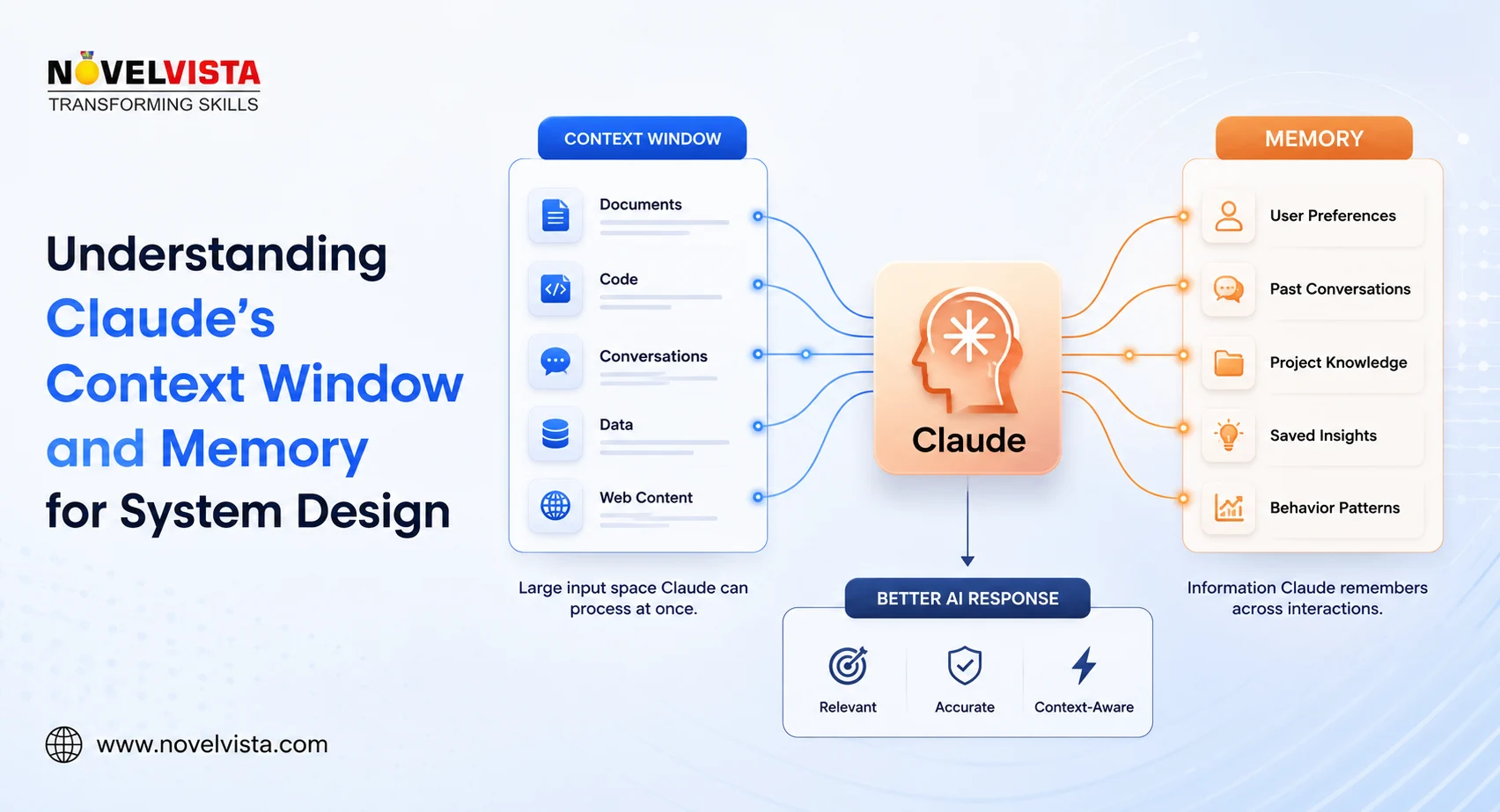
When developers build an AI-powered application using Claude, two concepts often create confusion: the context window and memory. They may sound similar, but they solve very different problems.
The context window determines how much information Claude can process during a request. Memory determines what information an application can preserve and reuse across conversations or sessions. Understanding this distinction is essential when designing reliable AI assistants, coding agents, enterprise copilots, and retrieval-augmented generation systems.
What Is Claude’s Context Window?
A context window is the total amount of information Claude can consider while generating a response. It may include:
- System instructions
- User messages
- Previous assistant responses
- Uploaded document content
- Tool definitions and tool results
- Retrieved knowledge
- Images and related tokens
- The model’s generated output
Current Claude models vary in capacity. Several Claude models support context windows of up to one million tokens, while other models continue to use a 200,000-token context window. The available capacity depends on the selected model and deployment platform.
A large context window allows Claude to analyze extensive codebases, lengthy contracts, research documents, support histories, or technical specifications in one workflow. However, a large window should not be treated as unlimited storage.
Every token included in the request consumes capacity. As conversations grow, older messages, repeated instructions, tool responses, and document content compete for the same space. More context can also increase latency, processing cost, and the possibility that important details become buried in irrelevant information.
For system designers, the objective should not be to send everything. It should be to send the smallest set of information required to make the correct decision.
Context Is Not Permanent Memory
Claude can reference information earlier in the same conversation because that information remains within the active context. This can appear like memory, but it is temporary.
Once a new API conversation begins, Claude does not automatically know what happened in a previous session unless the application provides that information again. The application must therefore manage persistent state outside the model.
A production architecture might store long-term information in:
- A relational or document database
- A vector database
- A user profile service
- A conversation-summary store
- An object storage platform
- An enterprise knowledge management system
When the user returns, the application retrieves the relevant information and places it into Claude’s context. Claude then reasons over that information as though it were part of the current conversation.
This architecture is more reliable than expecting the model itself to function as a permanent database.
How Claude Projects and Memory Work
Claude Projects provide self-contained workspaces with their own chats, instructions, and knowledge bases. Users can upload documents, source code, reference materials, and other information that Claude can use across conversations within the project.
Claude also provides cross-conversation memory capabilities on eligible paid plans. These features can help Claude reference relevant information from previous interactions and maintain project summaries across chats.
For large project knowledge bases, Claude can use retrieval-augmented generation. Instead of loading every document into the active context, the system searches the project knowledge base and retrieves only the information relevant to the current request. Anthropic states that this approach can expand project knowledge capacity by up to ten times compared with relying exclusively on the context window.
This is an important system-design principle: stored knowledge and active context should remain separate.
A Practical Memory Architecture
A well-designed Claude application usually needs multiple memory layers.
Working memory contains the immediate conversation, current task, recent tool results, and active instructions.
Episodic memory stores summaries of previous conversations, decisions, incidents, or completed tasks.
Semantic memory stores stable facts, such as product documentation, policies, technical standards, customer preferences, and organizational knowledge.
Procedural memory contains instructions describing how the system should operate, including workflows, approval rules, response formats, security restrictions, and escalation procedures.
Before each Claude request, an orchestration layer should identify the user’s intent, retrieve relevant memories, remove duplicate or outdated information, and construct a structured prompt.
Managing Long-Running Conversations
Long conversations should not grow indefinitely. A better approach is to periodically summarize completed sections and preserve important decisions in structured form.
For example, a coding agent might retain:
- The current objective
- Files already modified
- Architectural decisions
- Tests performed
- Known failures
- Remaining tasks
Raw terminal logs and outdated debugging discussions can then be removed from the active context.
Claude also supports prompt caching, which allows applications to reuse stable prompt prefixes such as system instructions, tool definitions, examples, and background documents. This can reduce processing cost and latency for repetitive workloads.
Final System-Design Principle
Claude’s context window is a reasoning workspace, not a permanent storage layer. Memory should be intentionally designed using databases, summaries, retrieval systems, project knowledge, and clearly governed user profiles.
The strongest architecture does not ask Claude to remember everything. It ensures that Claude receives the right information, at the right time, in the right structure.
When context management and memory architecture work together, Claude becomes more consistent, scalable, cost-efficient, and capable of supporting complex enterprise workflows.

 English
 Arabic
 French
 Spanish
 Portuguese
 Deutsch
 Dutch
Dutch
 Italiano
 Russian
 Romaian
 Portuguese (Brazil)
 Greek
Greek
