


Embossed Logo Packaging for Premium Rigid Boxes
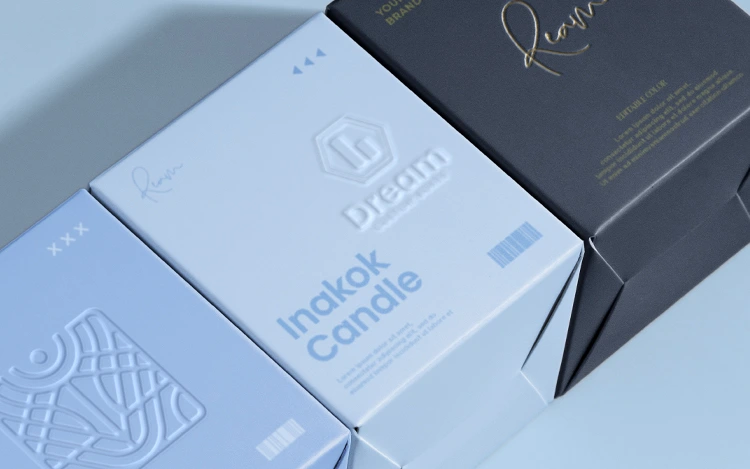
Embossing, pressing a design into board so it rises above the surface rather than sitting flat on top of it, has become one of the most requested finish treatments among brands positioning themselves at the premium end of their category.
Unlike foil stamping or high-gloss print, embossing communicates through touch as much as sight, which is exactly why it works so well on rigid boxes: the material's rigidity is what makes a crisp, deep emboss possible in the first place.
This tactile quality is difficult to replicate through digital marketing or product photography alone, which is part of why brands increasingly treat it as a differentiator specifically for the physical unboxing moment, a touchpoint screens simply can't deliver.
Why Embossing Outperforms Flat Print for Premium Positioning
A flat printed logo, no matter how well-designed, reads the same to the eye whether it's on a $10 product or a $200 one. An embossed logo introduces a dimensional cue that most customers associate, often without consciously naming it, with intentional, higher-cost craftsmanship.
That association is doing real work for brands trying to justify a premium price point through packaging alone.
The effect compounds when embossing is combined with a matte soft-touch laminate base, since the contrast between the smooth surface and the raised, often slightly glossy embossed element creates a tactile moment customers are more likely to notice and remember.
Brands report that this specific combination, soft-touch base with embossed accent, is currently the single most requested premium finish pairing.
How Embossing Actually Works on Rigid Construction
Embossing requires a custom metal die pressed into the board under heat and pressure, which means it's a setup-cost-driven finish, the die itself is a fixed cost regardless of run size, so per-unit cost improves meaningfully at higher volumes.
Rigid board's thickness gives embossing more depth to work with than thinner folding carton stock, which is part of why the effect reads as more substantial on rigid packaging specifically.
The die-making process itself typically adds a modest amount of lead time to a first order, since it requires a separate proofing step to confirm the design translates cleanly into a dimensional emboss before the die is finalized for production.
- Blind embossing: raised detail with no additional color, purely tactile
- Embossing with foil: combines dimensional detail with metallic color contrast
- Debossing: the inverse technique, pressing the design inward for a different tactile effect
- Combination finishes: embossed logo against a soft-touch matte base is the most requested pairing
Where the Cost Actually Goes
Custom rigid boxes with embossed logo detailing cost more primarily because of the die-making step, not because embossing itself is an expensive per-unit process.
Once the die exists, running it across a production batch adds comparatively little to per-unit cost, which is why embossing tends to make more financial sense for brands ordering consistent volume of the same design rather than frequently changing packaging.
Brands planning frequent seasonal redesigns should factor the repeated die cost into their overall packaging budget, since a new die is typically required whenever the embossed design itself changes, even if the underlying box structure stays the same.
Here's what most buyers overlook: a single well-placed embossed logo element frequently reads as more premium than embossing an entire pattern across the box surface. Restraint, paired with confident placement, tends to outperform coverage.
Getting Started With Embossed Packaging
If you're sourcing custom rigid boxes at scale, Alpha Global Packaging offers fully customizable options with low minimum order quantities, including embossed and combination finish treatments for brands ready to add this level of detail to their packaging.
For brands considering the investment, the die-making step is the right place to start the conversation, confirming your logo or design translates well into a dimensional emboss before committing to a full specification avoids costly rework later.
Is Embossing Right for Your Brand?
Embossed detailing works best for brands with a strong, simple logo mark and a packaging program stable enough to justify the die investment.
Brands still iterating on branding or ordering smaller, more frequent custom runs may find foil stamping or spot UV finishes deliver a similar premium signal with less upfront commitment.
As a general rule, if your logo mark is simple enough to recognize in silhouette alone, it's likely a strong candidate for embossing, complex, detail-heavy logos tend to lose definition when translated into a purely dimensional, single-color treatment.
Pairing Embossing With Other Finish Elements
Embossing rarely appears alone on a finished box, it's usually paired with at least one other finish element to create contrast.
Foil stamping is the most common pairing, since a metallic foil applied within an embossed area creates a dimensional, reflective effect that reads as more intricate than either technique alone.
Color also plays a role that's easy to underestimate. Embossing on a dark, saturated board color tends to catch shadow more dramatically than embossing on a lighter color, since the raised detail creates more visible contrast under typical retail or photography lighting.
Brands designing specifically for photography and video content should test their emboss under the lighting conditions their unboxing content will actually be filmed in.
For brands weighing embossing against other premium finish options, it helps to think in terms of sensory channel: foil stamping is primarily a visual effect, soft-touch lamination is primarily tactile, and embossing sits at the intersection of both.
Which is a meaningful part of why it has become such a popular finish for brands wanting maximum impact from a single treatment.
Caring for the Die Investment Over Time
Because the embossing die represents a real fixed investment, it's worth asking your manufacturer how dies are stored and maintained between orders.
A well-maintained die can be reused across many production runs without degradation, protecting the value of that upfront cost across your packaging program's full lifespan.
Brands should also clarify die ownership terms before committing, some manufacturers retain the die as part of their production equipment, while others transfer ownership to the brand.
This distinction matters if you ever decide to switch manufacturers, since a brand-owned die can sometimes transfer to a new production partner, while a manufacturer-owned die typically cannot.
For brands with multiple product lines using variations of the same logo mark, it's worth discussing upfront whether a single base die can be adapted across sizes, or whether each box format will require its own separate die, a detail that materially affects the total upfront investment required to roll embossing out across a full catalog.
Brands should also budget time for a physical proof review before greenlighting the full die order, since a digital rendering of an embossed design can look noticeably different once pressed into real board, depth, shadow, and edge sharpness are difficult to judge accurately on screen.

 English
 Arabic
 French
 Spanish
 Portuguese
 Deutsch
 Turkish
 Dutch
Dutch
 Italiano
 Russian
 Romaian
 Portuguese (Brazil)
