


How to Spot a Premium Real Leather Bomber Jacket Fast
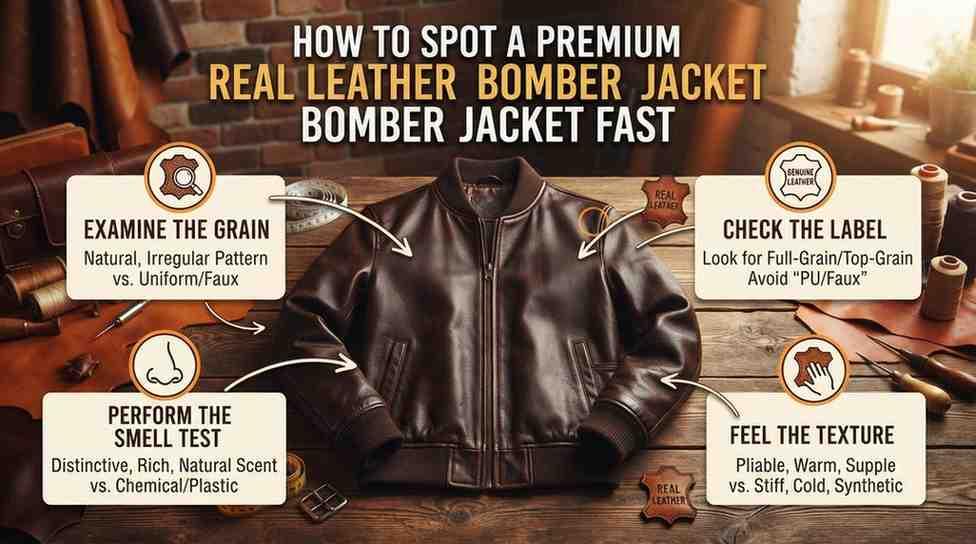
A premium real leather bomber jacket should look good, feel substantial, and improve with age. The problem is that synthetic materials have become convincing enough to fool buyers in product photos. Smooth polyurethane can copy leather grain, while clever lighting can make a thin jacket appear richer than it is.
You do not need to be a leather expert to make a better choice. A few quick checks can reveal the quality of the hide, stitching, hardware, lining, and construction. Once you know what to examine, you can spot a well-made real leather bomber jacket without spending an hour comparing tiny details.
This guide covers the fastest checks you can use online or in person. Some signs take only seconds to notice, yet they can save you from buying a jacket that cracks, peels, or loses its shape after one season.
Start with the leather surface
Look closely at the surface before checking anything else. Natural leather rarely has a perfectly identical pattern across every panel. A premium real leather bomber jacket usually shows small differences in grain, pores, creases, or color depth.
Those differences should be subtle. Large scars, badly matched panels, or random discoloration may point to careless material selection. On the other hand, a surface that looks completely uniform can suggest coated split leather or a synthetic substitute.
Zoom in on product photos when shopping online. Examine the sleeves, chest, collar, and pockets rather than relying on one polished front image. A trustworthy listing should show enough detail for you to inspect the real leather bomber jacket from several angles.
Natural grain should not look printed
Artificial grain often repeats. You may notice the same wrinkle, pore pattern, or texture appearing in several places. Natural hide does not behave like wallpaper.
A quality real leather bomber jacket may have a smoother chest panel and slightly more texture around the sleeves. That is normal because different sections of the hide stretch and respond differently during production.
Be cautious when a seller describes a jacket as leather but avoids showing close-up images. Premium materials usually look better under closer inspection, not worse.
Check how the material moves
Leather should respond naturally when bent or pressed. It develops fine wrinkles around the pressure point, then relaxes when released. A real leather bomber jacket will usually move with a soft, slightly uneven pattern rather than forming one sharp plastic crease.
Synthetic material often feels too springy or stiff. It may fold like coated fabric, especially around the elbows and pocket openings. Thin faux leather can also make a faint crackling sound when handled.
Do not confuse stiffness with poor quality immediately. Cowhide jackets can feel firm when new, while lambskin is usually softer from the first wear. The key is how the surface reacts. A premium real leather bomber jacket should bend without looking brittle.
Use smell as a supporting clue
Natural leather has a warm, earthy scent created by the hide and tanning process. Faux leather often smells like plastic, glue, vinyl, or chemicals. This can help when inspecting a jacket in person.
Smell should never be your only test. Manufacturers may add fragrances to packaging, and some leather treatments have a strong chemical odor when new. Still, a real leather bomber jacket should not smell like a plastic raincoat after it has been aired out.
When buying online, read customer reviews for comments about odor. Repeated complaints about a heavy plastic smell deserve attention, particularly when the product description makes broad claims without naming the leather type.
Inspect unfinished edges and hidden areas
The easiest clues are often inside the jacket. Check the back of a pocket flap, the edge behind the zipper, the underside of the collar, or any exposed seam allowance.
Natural leather usually has a fibrous or suede-like reverse side. Synthetic leather often has a woven textile backing. If the back looks like cloth with a plastic coating attached to it, the jacket is probably not made from solid hide.
A premium real leather bomber jacket should also have properly finished edges. Raw leather edges can be painted, folded, or stitched, but they should not look flaky or loosely glued.
Online listings may include photos of the interior or pocket construction. These images are useful because they reveal details that front-facing photos can hide.
Feel the weight, but judge it by leather type
Many buyers assume heavier always means better. That is not quite right. Weight depends on the hide, thickness, lining, and intended season.
A cowhide real leather bomber jacket will usually feel heavier and more structured than a lambskin version. Goatskin can sit between the two, offering strength without excessive bulk. Lightweight leather is not automatically cheap if the hide feels supple and the construction is clean.
What should concern you is a jacket that feels strangely weightless, papery, or hollow. A premium real leather bomber jacket should have enough body to hold its shape when placed on a hanger.
It should not collapse like a thin shirt unless it was intentionally designed as an ultra-light fashion layer.
Examine the stitching line by line
Good leather is only one part of a good jacket. Poor stitching can ruin expensive hide.
Look for straight seams, even stitch length, and clean corners. The stitching around pockets, cuffs, shoulders, and zippers receives the most stress, so those areas deserve extra attention. A well-made real leather bomber jacket should not have loose threads, skipped stitches, or puckered seams.
Leather keeps needle holes. A factory cannot simply remove a crooked seam and stitch it again without leaving marks. Clean stitching therefore tells you a great deal about production standards.
Check whether the left and right sides look balanced. Pocket openings should sit at the same height, ribbed cuffs should match, and shoulder seams should follow the same line.
Test the zipper and metal hardware
Run the main zipper several times when shopping in person. It should move smoothly without catching the lining. The pull should feel secure rather than thin or loose.
A premium real leather bomber jacket deserves hardware that can handle regular wear. Weak zipper teeth, lightweight snaps, and poorly attached buckles often fail before the leather does.
Look at the color and finish of every metal part. The main zipper, pocket zippers, snaps, and buckles should look like they belong together. Mixed finishes can work as a design choice, but random differences may point to cheaper production.
Online shoppers should enlarge the hardware photos. Clear branding on a zipper is helpful, though an unbranded zipper is not automatically poor. Smooth construction matters more than a stamped name.
Pay attention to the ribbed collar, cuffs, and waistband
Bomber jackets rely on ribbed trim for their shape. Weak ribbing stretches quickly and can make an otherwise attractive jacket look tired.
Stretch the cuff gently and watch whether it returns to its original size. The knit should feel dense, soft, and secure. A quality real leather bomber jacket normally has ribbing that sits flat against the wrists and waist without feeling restrictive.
Check how the ribbed sections connect to the leather. The seam should be clean, with no twisting or bunching. Loose attachment points can split after repeated wear.
Also inspect the collar. It should hold its form instead of folding unevenly or pulling the neckline out of shape.
Look inside the jacket
The lining reveals how much attention the manufacturer gave to areas most people do not see. Thin, rough lining can tear around the sleeves or pockets, while loose fabric may catch in the zipper.
A premium real leather bomber jacket should have a lining that feels comfortable over a shirt or sweater. Polyester is common and practical, while satin-style linings create a smoother feel. Quilted linings provide more warmth but also add weight.
Inspect the seams inside the sleeves and near the armholes. These areas face constant movement. Thread ends, uneven stitching, and exposed adhesive suggest rushed construction.
Inside pockets are another useful clue. Their openings should be reinforced because phones, wallets, and keys place repeated pressure on the fabric.
Read the product description carefully
A serious seller should state the leather type instead of relying on vague phrases such as leather feel, leather look, or premium material. Those terms do not confirm that a product is a real leather bomber jacket.
Look for clear descriptions such as lambskin leather, cowhide leather, goatskin leather, full-grain leather, or top-grain leather. The listing should also identify the lining, closure, pocket layout, and care requirements.
Be careful with the phrase genuine leather. It confirms that animal hide is present, but it does not always indicate the highest grade. Construction, thickness, tanning, finishing, and panel selection still matter.
A transparent return policy is equally important. Even a good real leather bomber jacket may not suit your build, preferred fit, or local climate.
Choose the right fit for the style
A classic bomber should sit close to the body without pulling across the chest. The waistband usually ends near the hips, while the shoulder seams should align with your natural shoulders unless the jacket has an intentionally relaxed cut.
Men searching for a structured flight-inspired shape can compare options in the Mens real leather bomber jacket collection. Look at the model measurements, garment size chart, and room around the chest before ordering.
Women may prefer a fitted waist, cropped cut, oversized silhouette, or classic unisex shape. The Womens real leather bomber jacket collection provides different cuts that can be styled with denim, trousers, skirts, or dresses.
A real leather bomber jacket should allow comfortable arm movement. Raise your arms, bend your elbows, and zip the jacket fully. Slight resistance is normal with firmer leather, but the back and shoulders should not feel strained.
Compare the price with the construction
Real leather costs more to source, grade, cut, and sew than synthetic material. An extremely low price should make you examine the listing more carefully.
Price alone does not prove quality. Some buyers pay extra for a label, while smaller sellers may offer better value. Judge the complete real leather bomber jacket by its hide, panel matching, hardware, lining, stitching, and return policy.
Large pieces of leather usually cost more because they require cleaner sections of hide. Jackets made from many tiny panels can use leftover material. Panelled designs are not always bad, but the joins should appear intentional and balanced.
A fast inspection you can complete in one minute
Start by scanning the grain for natural variation. Bend a sleeve and watch how the surface wrinkles. Check an inside edge for a fibrous backing. Run the zipper, inspect the pocket stitching, stretch one cuff, and read the material label.
That quick routine will not tell you everything, but it can expose many common problems. A premium real leather bomber jacket should pass each check without forcing you to excuse weak construction.
For online purchases, use the same order with product images. Zoom into the grain, inspect seams, study the cuffs, read the specifications, and review the return conditions before paying.
How to protect the jacket after purchase
Store leather on a broad, supportive hanger so the shoulders keep their shape. Keep it away from direct sunlight, heaters, and damp storage spaces.
If the jacket gets wet, blot the surface with a clean cloth and let it dry naturally. Do not place a real leather bomber jacket beside a radiator or use a hair dryer. Fast heat can remove natural oils and leave the hide stiff.
Use a conditioner made for the specific leather finish, and test it on a hidden area first. Too much conditioner can darken the surface or make it feel greasy.
Avoid plastic garment bags for long-term storage. Leather needs airflow. A breathable fabric cover protects the jacket from dust without trapping moisture.
Frequently asked questions
How can I tell real leather from faux leather quickly?
Check the grain, movement, smell, backing, and edges. A real leather bomber jacket usually has small surface variations, fine wrinkles when bent, and a fibrous reverse side. Faux leather often has repeated grain and a fabric backing beneath a plastic coating.
Does real leather always feel heavy?
No. Cowhide is often heavy, while lambskin can feel light and soft. A premium real leather bomber jacket should feel appropriate for its leather type rather than meeting one fixed weight standard.
Is genuine leather the same as full-grain leather?
No. Genuine leather is a broad term for material made from animal hide. Full-grain leather retains the natural outer surface and is generally valued for durability and character. The quality of a real leather bomber jacket still depends on tanning, finishing, cutting, and construction.
Should a new leather jacket feel stiff?
Some stiffness is normal, particularly with thick cowhide. The jacket should soften as it is worn. A real leather bomber jacket should not feel brittle, coated in hard plastic, or likely to crack when bent.
Can product photos confirm that a jacket is real leather?
Photos can reveal grain, stitching, hardware, and construction, but they cannot confirm everything. Read the material description, customer reviews, size guide, and return policy before purchasing.
How long should a quality leather bomber last?
With sensible storage and occasional conditioning, a well-made real leather bomber jacket can remain wearable for many years. Hardware, lining, stitching, and daily treatment affect its lifespan as much as the hide itself.
Find a bomber jacket made for regular wear
The fastest way to judge a leather bomber is to look beyond the front photo. Grain, movement, edges, stitching, hardware, lining, ribbing, and fit tell the full story.
Browse The Leather Jackets collections to compare cuts, colors, and leather finishes. Choose a real leather bomber jacket that feels comfortable now, has room to develop character, and is built well enough to stay in your wardrobe season after season.

 English
 Arabic
 French
 Spanish
 Portuguese
 Deutsch
 Turkish
 Dutch
Dutch
 Italiano
 Russian
 Portuguese (Brazil)
 Greek
Greek
