


Employee Stress: A Business Risk, Not Just an HR Responsibility
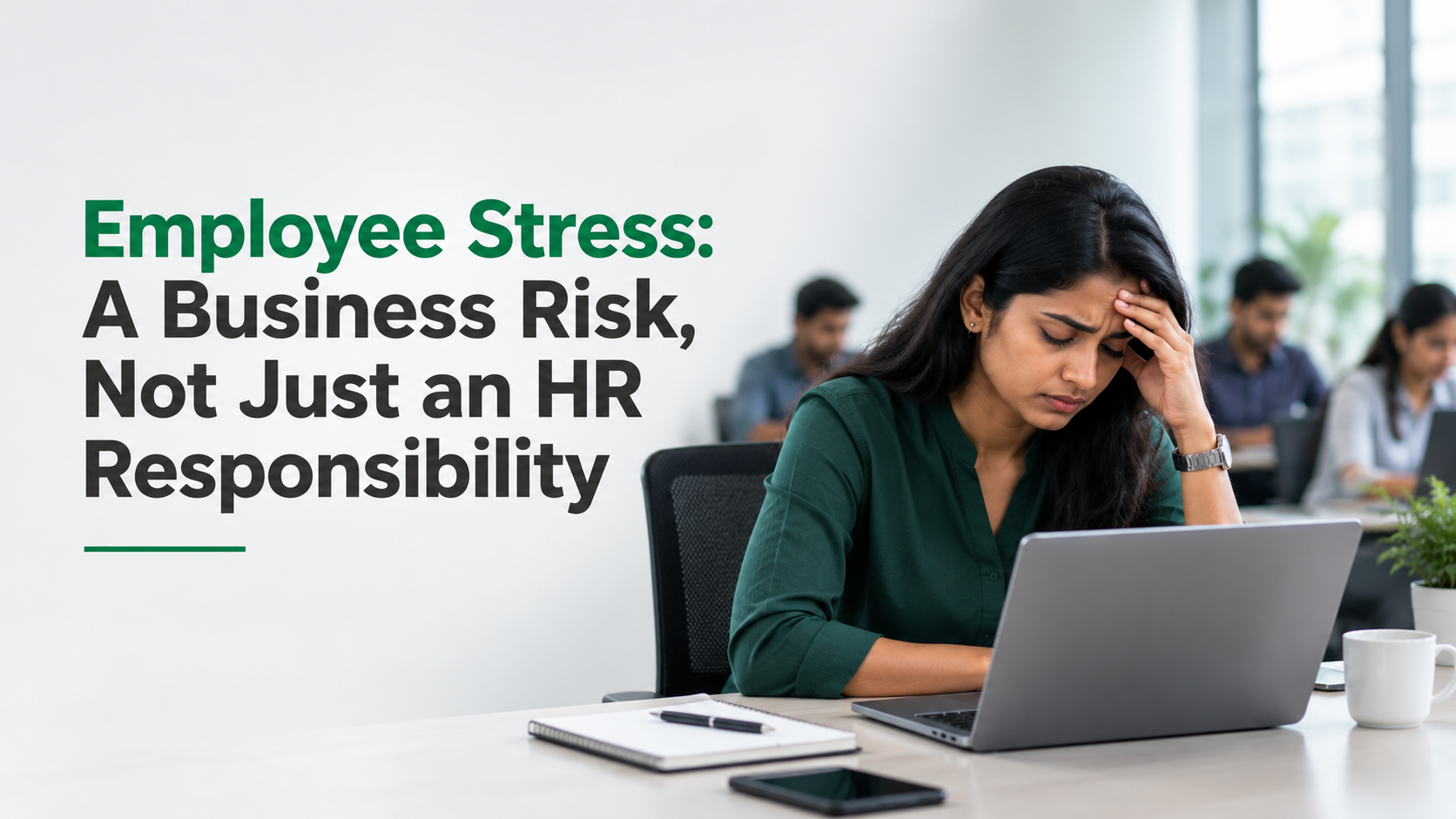
For years, employee stress has been treated as a personal issue something individuals should manage on their own time, with HR stepping in only once it visibly affects performance. That framing is outdated and, increasingly, expensive. Chronic workplace stress is a measurable business risk that touches productivity, retention, safety, and organisational reputation. Treating it purely as an HR matter, rather than a leadership and business priority, leaves significant value on the table.
Reframing Stress as a Business Metric
Workplace stress does not stay contained within an individual's personal experience — it shows up in the numbers that leadership already tracks:
- Attrition: Employees experiencing chronic stress are significantly more likely to leave, taking institutional knowledge and hiring investment with them
- Absenteeism: Stress-related physical and mental health issues drive short-term sick leave patterns
- Presenteeism: Employees who are physically present but mentally overwhelmed produce lower-quality work, make more errors, and take longer to complete routine tasks
- Safety incidents: In operational and high-risk environments, chronic stress and fatigue are linked to increased error rates and accidents
Framed this way, stress is not a soft-side concern — it is a driver of hard financial outcomes that leadership already monitors elsewhere.
The Financial Scale of the Problem in India
Employer-focused research in India has estimated that poor mental health, closely tied to chronic workplace stress, costs Indian businesses billions of dollars annually. This is driven overwhelmingly by lost productivity rather than direct medical costs, meaning the financial impact often goes unnoticed in standard budgeting and risk assessments, even as it steadily erodes performance.
Globally, workplace stress and burnout have been estimated to cost the world economy hundreds of billions of dollars annually through turnover and reduced output — a scale that puts it in the same conversation as other major operational risks businesses actively manage.
Why Stress Has Been Historically Under-Managed
It's Been Seen as Individual, Not Systemic
Traditional HR approaches have often focused on individual coping — offering an employee assistance helpline number, or a yoga session without examining whether workload, staffing, or management practices are structurally driving stress across teams.
It Doesn't Show Up on a Single Line Item
Unlike a safety incident or a compliance breach, stress-related costs are distributed across attrition, absenteeism, and reduced output — making them easy to overlook in typical financial reporting, even though the cumulative impact is significant.
Stigma Suppresses Reporting
Employees experiencing stress often don't disclose it, fearing it will be seen as a performance or resilience issue rather than a legitimate response to workload or conditions. This makes the true scale of the problem harder for leadership to see directly.
Why This Belongs on the Business Risk Register
It Affects Retention Directly
High-stress environments are consistently linked to higher voluntary attrition, particularly among high performers who have the most external options. Losing experienced employees to a preventable cause is a direct, quantifiable cost.
It Undermines Decision-Making
Chronic stress affects cognitive function — memory, judgment, and the ability to manage complex or ambiguous situations. In leadership and client-facing roles, this has direct implications for the quality of business decisions being made.
It Creates Legal and Compliance Exposure
Workplace stress that crosses into harassment, discrimination, or unsafe working conditions carries legal risk. Increasingly, occupational health and safety frameworks are expanding to explicitly cover psychosocial risk factors, not just physical hazards.
It Damages Employer Brand
In a market where employer reviews are public and widely read by prospective candidates, a reputation for burnout culture directly affects hiring costs and quality of applicants.
Moving Stress Management From HR to Leadership
Make It a Standing Business Metric
Just as safety incidents or financial variances are reviewed at a leadership level, workplace stress indicators — engagement survey results, absenteeism trends, exit interview themes — deserve the same visibility.
Address Root Causes, Not Just Symptoms
Wellness perks are not a substitute for addressing unsustainable workload, unclear role expectations, or chronically understaffed teams. Leadership needs to be willing to look at structural drivers, even when the fix (more headcount, realistic deadlines) is harder than a wellness webinar.
Equip Managers as the First Line of Response
Managers interact with employees daily and are best positioned to notice early stress indicators — but only if they are trained to recognise them and know how to respond. Mental health literacy training for managers has consistently been linked to improved help-seeking behaviour and earlier intervention.
Build Confidential, Genuinely Accessible Support
Employee assistance programmes and counselling access only reduce risk if employees trust and actually use them. Utilisation rates, not just availability, should be tracked as a meaningful metric.
The Return on Treating Stress as a Business Priority
Organisations that invest systematically in stress prevention — through manager training, workload review, and accessible mental health support consistently report measurable returns: reduced absenteeism, improved retention, and stronger engagement scores. Analyses of workplace mental health investment broadly suggest a strong return for every unit spent on prevention, reinforcing that this is a performance lever, not a cost centre.
What a Leadership-Level Stress Strategy Looks Like
- Regular, anonymous pulse surveys reviewed at leadership level, not just HR
- Workload audits for teams showing high attrition, absenteeism, or declining engagement
- Manager training in recognising and responding to stress and mental health concerns
- Clear escalation pathways from managers to professional mental health support
- Explicit inclusion of psychosocial risk in occupational health and safety frameworks
- Leadership visibly modelling healthy boundaries around hours and availability
Conclusion
Employee stress is not a private struggle to be managed quietly by HR after the fact — it is a measurable, manageable business risk with direct financial and reputational consequences. Organisations that continue to treat it as a soft-side concern will keep paying for it through attrition, reduced output, and reputational damage. Those that elevate it to a leadership-level priority, backed by real structural change rather than surface-level wellness initiatives, stand to gain a genuine and durable competitive advantage.

 Arabic
 French
 Spanish
 Portuguese
 Deutsch
 Turkish
 Dutch
Dutch
 Italiano
 Russian
 Romaian
 Portuguese (Brazil)
 Greek
Greek
