


Dried Tomato Lycopene-Rich Flake Ingredients Market to Reach USD 5.44 Billion by 2036
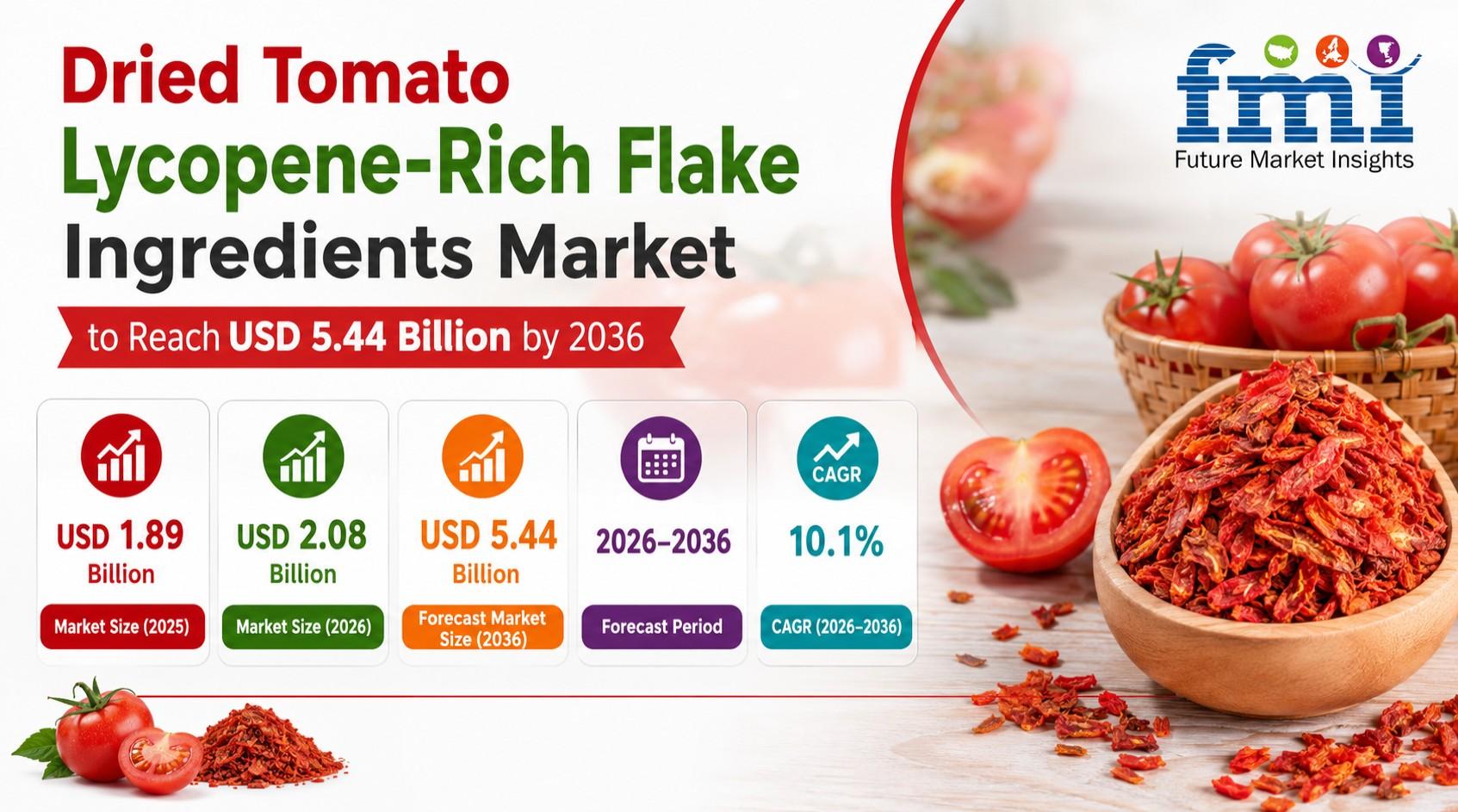
The global market for dried tomato lycopene-rich flake ingredients is witnessing rapid commercial acceleration, according to latest insights by future market insights. As food manufacturers face mounting regulatory and consumer pressure to replace synthetic red colorants, the demand for stable, botanical alternatives has intensified. The global industry, which was valued at USD 1.89 billion in 2025, is projected to reach USD 2.08 billion in 2026. Expanding at a strong Compound Annual Growth Rate (CAGR) of 10.1% over the ten-year forecast period, the market is anticipated to achieve a total valuation of USD 5.44 billion by 2036, creating an absolute incremental dollar opportunity of USD 3.36 billion.
“Dried tomato lycopene-rich flake ingredients are becoming a clean-label color and functional formulation decision rather than a simple recipe addition. Buyers want intense natural red coloration and standardized antioxidant delivery without compromising on product stability or visual texture. Suppliers that prove lycopene retention throughout advanced dehydration and help processors optimize color stability under varying shelf life environments should gain stronger contract conversion.” Nandini Roy Choudhury, Principal Consultant at FMI
Request a Sample Report: https://www.futuremarketinsights.com/reports/sample/rep-gb-32776
Market Performance Overview (2026–2036)
To map out the key factors shaping this industrial migration, an analysis of the core configurations, application destinations, and transaction pathways highlights where commercial volume is concentrated:
· Conventional Nature (62.0% share): Remains the leading choice for high-volume reformulation programs because standard agricultural inputs align with mass-market grocery unit economics.
· Direct B2B Sales Channel (58.0% share): Commands the distribution network as multi-season commercial buyers require transparent, un-interrupted chain-of-custody documentation.
· Food Processors End User (44.0% share): Represents the largest purchasing block, possessing the scale to secure pre-season volume contracts and minimize spot-market price risks.
· Sun-Dried Method (38.0% share): Leads the dehydration category due to its capital-efficient processing profile in regions with high solar exposure.
· Sauces Application (31.0% share): Serves as the primary application destination, as savory liquid matrices effortlessly integrate natural vegetable notes and particulate visibility.
Technical Drivers and Formulation Advantages
The industrial transition toward concentrated tomato-derived lycopene flakes is underpinned by three key technical factors:
Cellular Matrix Protection
A primary challenge when using natural plant extracts in high-temperature manufacturing such as factory extrusion is rapid pigment degradation. Flake formats offer distinct structural benefits because the target carotenoids remain trapped within the raw vegetable cell walls, providing natural thermal protection until the matrix is hydrated during processing.
Synthetic Color Replacement
Global regulatory scrutiny against artificial food dyes has forced clean-label snack and condiment reformulation. Dehydrated tomato flakes deliver an authentic red hue profile along with antioxidant positioning, satisfying both corporate safety standards and premium retail listing requirements.
Storage and Dehydration Advancements
Modern recovery techniques maximize lycopene retention through advanced vacuum and air-drying controls. Minimizing chemical oxidation during processing ensures extended shelf life and color stability during ambient warehouse storage, minimizing lot-to-lot color variability.
Industrial Infrastructure Challenges
Commercial scale-up remains constrained by operational realities across the manufacturing line:
· Sun-Drying Crop Inconsistency: While sun-dehydration requires low initial capital investment, natural weather fluctuations introduce high batch variability regarding final moisture and pigment levels. Factory managers must invest in secondary batch blending to maintain color consistency across large production runs.
· Suspension Limits in Liquids: Insoluble vegetable fibers naturally separate over time in low-viscosity applications. This structural sedimentation restricts immediate deployment in clear beverage systems, keeping adoption concentrated in thick savory bases like sauces and seasonings.
Regional Growth Outlook
The geographical spread reveals an aggressive infrastructure expansion near primary cultivation belts, outperforming mature distribution regions:
· India (11.0% CAGR): The fastest-growing market globally, propelled by rising local dehydration plant investments adjacent to agricultural zones to lower cross-border logistics costs.
· South Korea (10.8% CAGR): Driven by convenience food innovations that integrate functional, antioxidant-rich components into premium ready meals.
· China (10.4% CAGR): Expanding due to massive domestic vegetable extraction scale and localized manufacturing lines catering to direct factory supply.
· Germany (10.0% CAGR): Led by strict European Union compliance policies screening out synthetic color additives in favor of traceable botanical alternatives.
· United States (9.7% CAGR): Supported by large-scale snack portfolio reformulations and multi-year supply arrangements designed to secure volume stability.
· Japan (9.2% CAGR): Supported by preventative nutrition demands within an aging consumer demographic seeking functional ingredients.
· Italy (9.0% CAGR): Advancing as traditional Mediterranean processing facilities upgrade solar drying lines to meet strict export-grade food safety standards.
Competitive Landscape
The global landscape is highly fragmented, with major processors competing on sourcing security, agricultural network control, and dehydration technology. BCFoods holds a leading market share of approximately 9.5%, maintaining its position alongside established dehydration and botanical extraction specialists such as Lycored, Silva International, Kanegrade, Givaudan, Kapadiya Expo Company, and Harmony House Foods.
To hedge against localized crop disruptions and extreme weather risks, multinational food corporations are increasingly shifting toward supplier diversification, splitting long-term procurement contracts across distinct geographic climate zones.
Exclusive Discounts on Full Report: https://www.futuremarketinsights.com/reports/dried-tomato-lycopene-rich-flake-ingredients-market
Frequently Asked Questions
What is the projected valuation of the market in 2036?
The global market is projected to reach USD 5.44 billion by 2036, expanding from USD 2.08 billion in 2026 at a CAGR of 10.1%.
Why is the Direct B2B sales channel preferred by buyers?
Direct channels capture a 58.0% share because eliminating third-party intermediaries provides unbroken tracking trails, which are critical for passing strict retail residue and pesticide compliance audits.
What limits the application of lycopene-rich flakes in beverages?
Insoluble tomato plant matter naturally separates from liquid suspensions during storage, which can create undesirable texturing and sediment layers unless secondary chemical stabilizers are applied.
FMI Custom Research: Strategic Intelligence for Confident Decision-Making
In today's rapidly evolving business environment, leadership teams need more than market data they need clear, actionable intelligence tailored to their strategic objectives. FMI's Custom Research solutions are designed around the specific business questions organizations need answered, enabling executives to evaluate growth opportunities, validate investments, assess competitive dynamics, and reduce uncertainty before making critical decisions.
Key Executive Benefits
• Decision-Ready Insights tailored to business priorities
• Reduced Strategic Risk through validated market intelligence
• Market Entry Confidence with detailed competitive analysis
• Competitive Advantage supported by proprietary research
• Faster Growth Decisions through customized strategic insights
• Primary Market Validation from industry stakeholders
• Global Industry Expertise across diverse sectors
• Proven Track Record with thousands of consulting engagements
Business Impact
FMI helps organizations transform market complexity into strategic clarity, enabling leadership teams to identify growth opportunities faster, optimize resource allocation, strengthen competitive positioning, and make high-stakes business decisions with confidence.
To explore how FMI Custom Research can support your strategic priorities, please connect with our team at - sales@futuremarketinsights.com

 English
 Arabic
 Spanish
 Portuguese
 Deutsch
 Turkish
 Dutch
Dutch
 Italiano
 Russian
 Romaian
 Portuguese (Brazil)
 Greek
Greek
