


Optimizing Network Throughput on Raspberry Pi with Quectel EC200A
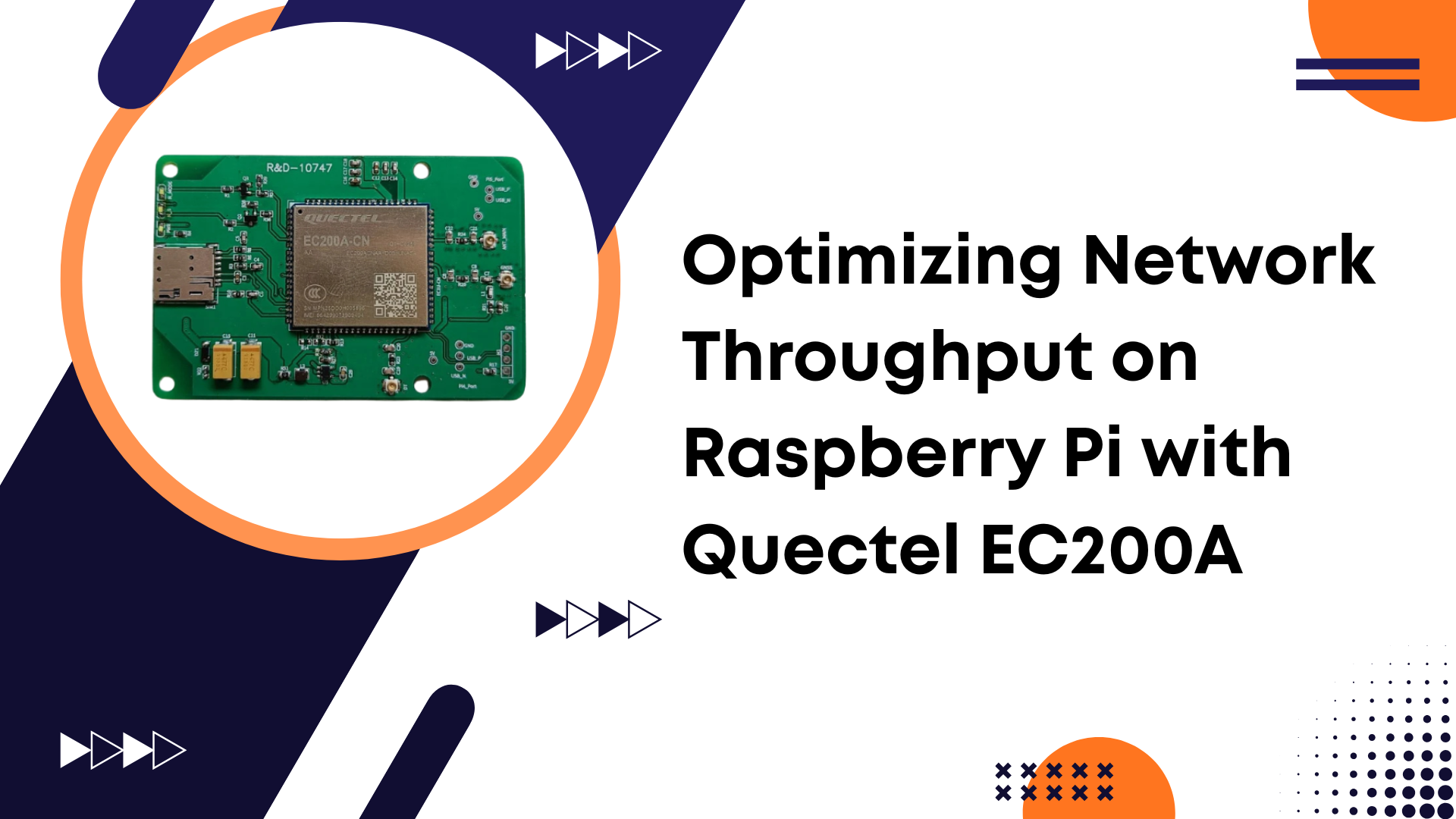
Edge computing setups often require high-speed wireless links. Single-board computers frequently operate in field environments without access to local Wi-Fi or wired lines. Operators deploy cellular hardware extensions to fix this connectivity problem. The Raspberry Pi 4G LTE HAT with Quectel EC200A offers a practical cellular solution for mobile infrastructure. This platform allows field nodes to send telemetry data, stream video feeds, and manage remote industrial assets.
This specific hardware choice fits many remote installations. The module uses standard 3GPP Release 9 LTE technology. This standard provides Category 4 LTE capabilities. It delivers theoretical data speeds up to 150 Mbps downlink. It also supports up to 50 Mbps uplink speeds. Achieving these maximum data speeds requires proper system choices. Hardware limits, protocol overhead, and software drivers influence the final throughput.
Understanding the Network Bottlenecks
A standard installation often falls short of maximum advertised speeds. Real-world testing reveals typical download rates of only 20 to 45 Mbps under basic setups. This gap occurs because of system limitations.
The primary bottleneck involves the connection medium between the host and the modem. The Raspberry Pi 4G LTE HAT with Quectel connects via dual interfaces. It uses the 40-pin GPIO header and an external USB cable. The GPIO header carries UART serial lines. UART connections operate at slow speeds. Standard UART configurations limit communication to 115,200 bits per second. This speed cannot handle 4G internet traffic.
Therefore, high-speed data transfer must utilize the USB interface. The module features a USB 2.0 High-Speed port. This interface supports a theoretical limit of 480 Mbps. This speed easily accommodates the 150 Mbps cellular capability. However, poor software driver selection can still limit performance. Choosing the wrong driver ruins the benefits of the USB connection. Developers must switch away from default communication methods to achieve better rates.
Choosing the Best Driver Mode
The Linux kernel interacts with the modem through different network modes. Each mode changes how the system encapsulates network packets.
1. Point-to-Point Protocol Mode
The Point-to-Point Protocol, or PPP, is an older method for cellular connections. It emulates a traditional dial-up modem over a serial port interface. PPP adds massive processing overhead to the single-board computer. The system must convert every IP packet into a serial stream. Real-world tests show PPP limits speeds to less than 30 Mbps. CPU utilization rises significantly during fast data transfers.
2. Ethernet Control Model
The Ethernet Control Model, or ECM, changes how the modem acts. It makes the cellular module appear as a USB Ethernet card. This mode bypasses serial port translation. It allows the system to transfer standard Ethernet frames directly. Network throughput often improves to 70 or 90 Mbps when using ECM.
3. Network Driver Interface Specification
The Network Driver Interface Specification, or NDIS, offers the highest performance. In Linux systems, the QMI_WWAN driver handles this operational mode. It uses Qualcomm MSM Interface protocols to bypass traditional network layers. This direct communication lowers data latency. It allows the Raspberry Pi 4G LTE HAT with Quectel EC200A to hit its true speed potential. NDIS mode lowers CPU load while increasing total network throughput.
Power and Signal Tuning
Digital configurations represent only half of the performance puzzle. Cellular hardware demands proper electrical current and clean RF environments.
1. Power Distribution Analysis
Cellular modems consume high amounts of electrical current during radio transmissions. The module can draw up to 2.0 Amps during network attachment bursts. The 5V pins on the GPIO header cannot supply this current safely. A standard 5V, 3A power supply attached to the main board will fail. It causes voltage drops, which lead to random modem resets.
2. Antenna Placement Rules
The Raspberry Pi 4G LTE HAT with Quectel relies on Multiple-Input Multiple-Output, or MIMO, systems. It utilizes two distinct antenna ports. The main antenna handles transmission and reception. The auxiliary antenna provides receiver diversity. Never leave the auxiliary antenna port empty. The secondary port assists in noise filtering. Connect high-gain omnidirectional antennas to both ports. Keep the elements at least twenty centimeters apart to prevent signal interference.
Troubleshooting Speed Inconsistencies
If your network speed drops unexpectedly, check these three common system indicators.
1. Temperature-Induced Throttling
The cellular module generates heat during long file transfers. Internal tracking shows that performance drops when the chip reaches 75 degrees Celsius. The modem automatically lowers its radio power to prevent permanent component damage. Attach thick thermal tape and an aluminum heatsink to the shield matrix of the module.
2. Base Station Congestion
Cellular speeds change depending on network utilization in the area. Use AT commands to check the received signal quality metrics:
3. Proper USB Port Connection
The Raspberry Pi 4G LTE HAT with Quectel EC200A requires a USB 3.0 link for top speed. If you plug the cable into a black USB 2.0 port, the interface maxes out early. Always use the blue slots on the single-board computer to guarantee full bus capability.
Performance Comparison Metrics
The table below shows real-world data rates collected across various network driver modes and hardware setups.
|
Setup Configuration |
Driver Mode |
Average Downlink |
Average Uplink |
Average Latency |
|
GPIO Pin Connection |
PPP Mode |
1.2 Mbps |
0.8 Mbps |
120 ms |
|
USB 2.0 Port Connection |
PPP Mode |
24.5 Mbps |
18.2 Mbps |
65 ms |
|
USB 2.0 Port Connection |
ECM Mode |
68.1 Mbps |
32.4 Mbps |
42 ms |
|
USB 3.0 Port Connection |
NDIS Mode |
114.3 Mbps |
44.1 Mbps |
28 ms |
Industrial Applications for Optimized HATs
Optimized cellular links expand the utility of single-board systems. Understanding specific use cases helps developers justify the configuration effort.
1. Environmental Monitoring Stations
Remote weather monitors gather vast amounts of telemetry data. They collect sensor inputs, barometric records, and wind patterns over long durations. High-resolution imaging systems also capture terrain changes. Sending raw files requires stable throughput. Modifying kernel network buffers ensures large image uploads do not fail.
2. Smart Agriculture Fields
Modern farms deploy field gates to handle soil tracking, automated irrigation, and drone mapping data. The gates must aggregate inputs from hundreds of low-power sensor nodes. Using NDIS mode minimizes processing overhead on the central processor. The board spends less energy handling network encapsulation and more energy processing field data.
3. Mobile Fleet Management
Commercial vehicles use tracking systems to stream route metrics and engine diagnostics. Delivery vans rely on cellular stability while driving through different cell towers. Setting the correct MTU prevents packet loss during tower handovers. This adjustment guarantees steady communication with central logistics servers.
Operational Maintenance Protocols
Maintaining network performance over long deployment lifecycles requires ongoing care. Software updates and electrical wear can degrade speeds over time.
-
Automated Reconnection Scripts: Cellular networks disconnect randomly due to provider resets. Implement a watchdog script that pings a reliable IP address every sixty seconds. If the ping fails, use AT commands to reset the radio interface.
-
Firmware Verification: Cellular carriers update tower software regularly. Ensure your modem runs the latest manufacturer firmware to maintain network compatibility.
-
Corrosion Inspections: Outdoor enclosures face humidity and temperature swings. Check antenna connections every six months for physical corrosion. Oxidation on SMA connectors degrades RF signal quality.
-
Log Rotation Setup: High-speed connections generate massive system logs. Configure the operating system to rotate log files daily. This step prevents the system storage from filling up completely.
Conclusion
Optimizing network throughput involves managing multiple system layers. The hardware capabilities of the Category 4 cellular module provide a strong foundation. However, default serial connections often limit performance. Developers can extract maximum speed from their Raspberry Pi 4G LTE HAT with Quectel EC200A installations by taking a systematic approach to driver selection and configuration.
By avoiding slow PPP driver structures, developers can bypass significant software bottlenecks. Switching to NDIS mode allows the single-board computer to process data packages efficiently. Additionally, providing adequate power prevents unexpected device drops under heavy network loads. Proper antenna management and MTU adjustments ensure stable data links over cellular networks.
These configuration choices help you achieve maximum throughput for field deployments. Utilizing the Raspberry Pi 4G LTE HAT with Quectel guarantees that your remote edge devices will transmit files reliably, even in challenging environments. Proper optimization preserves hardware investments and ensures continuous data availability.

 English
 Arabic
 French
 Spanish
 Portuguese
 Turkish
 Dutch
Dutch
 Italiano
 Russian
 Romaian
 Portuguese (Brazil)
 Greek
Greek
