


The Role of Professional Event Planners in Modern Corporate Programmes
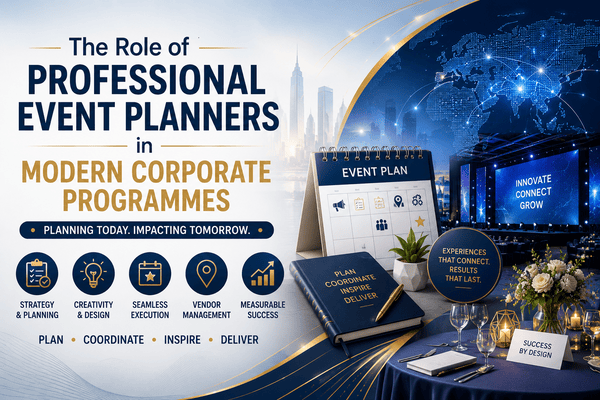
Corporate events have become more complicated than they used to be. Audiences are more international, expectations are higher, technical layers run deeper, and the cost of getting it wrong is more visible. In response, the role of the event planner has shifted from supporting function to strategic one.
Companies that used to handle their corporate events with internal coordination are increasingly bringing in professional planners much earlier in the process. The reasons are practical, and they are worth understanding for any organisation considering whether to make the same move.
From Logistics to Strategy
A decade ago, an event planner’s role was largely operational. Find a venue. Book the catering. Arrange the transfers. Run the day. The brief was logistics.
That definition no longer matches reality. Modern planners are involved in the strategic shape of the programme: how to design an agenda that holds attention, how to balance work with experiential moments, how to make a programme deliver against a clear business objective. The logistics still matter, but they sit underneath a more substantive layer.
Why Companies Are Engaging Planners Earlier
The biggest shift in how planners are used is timing. Companies used to bring in a planner once the venue was decided and the agenda was drafted. Now they engage at the briefing stage, before the major decisions are made.
The reason is simple. An Event Planner Thailand or any other market, brought in early, shapes the venue choice, the supplier mix, and the agenda design rather than just executing decisions that have already been made. The earlier the involvement, the better the programme tends to perform.
What the Best Planners Actually Do Differently
Not all planners deliver at the same level. The ones who consistently produce strong programmes tend to share a few habits.
They ask hard questions early. Rather than starting with logistics, they push the client to be clear about the business objective. A reward trip, a strategy offsite, and a product launch all need very different programmes, and the strongest planners refuse to start work until that distinction is made.
They prioritise the delegate experience. Operational delivery is a baseline, not an outcome. The best planners measure success by what delegates take away, not by whether the day ran on time.
They handle multiple supplier layers in house rather than subcontracting everything. Integration reduces handover risk and produces tighter delivery.
Where Specialisation Matters
Generalist planners can handle most formats, but specialist experience matters for the more complex programmes. A Mice Event Planner Thailand running international conferences, hybrid sessions, and multi destination programmes brings a different level of competence than a planner whose work is mostly local social events. For corporate clients, the question of relevant specialisation is worth asking explicitly when shortlisting.
The Common Mistakes
Companies that engage planners poorly tend to make the same errors. They bring the planner in too late. They under brief, expecting the planner to read the company’s mind. They split the work across multiple planners thinking it will lower the risk, when it usually creates coordination gaps.
Avoiding these is straightforward in theory. Brief the planner properly. Engage them at the start. Let them do the job.
The Direction of Travel
The role of the event planner will continue moving in a strategic direction. As corporate events become more complex and delegate expectations rise, the value of an experienced planner sits less in logistics and more in shaping programmes that actually work. The companies investing in this relationship earlier will continue producing stronger events than those treating it as a transactional service.

 Arabic
 French
 Spanish
 Portuguese
 Deutsch
 Turkish
 Dutch
Dutch
 Italiano
 Russian
 Romaian
 Portuguese (Brazil)
 Greek
Greek
