


Why Custom AI development Services Deliver Better ROI than Generic AI
A few years ago, companies rushed to adopt AI because they feared falling behind. The conversation was driven by excitement, not scrutiny.
Now the conversation sounds different. Executives are asking tougher questions.
- Where is the return?
- Why are teams still doing manual work?
- Why does the AI struggle with legacy systems?
- Why does expensive software feel disconnected from the business?
That shift matters.
The early wave of AI adoption was driven by novelty. The next phase is being driven by performance. Companies are no longer impressed by flashy demos or generic automation claims. They want AI that solves actual operational problems.
And that is exactly why demand for custom AI development services has exploded over the last two years.
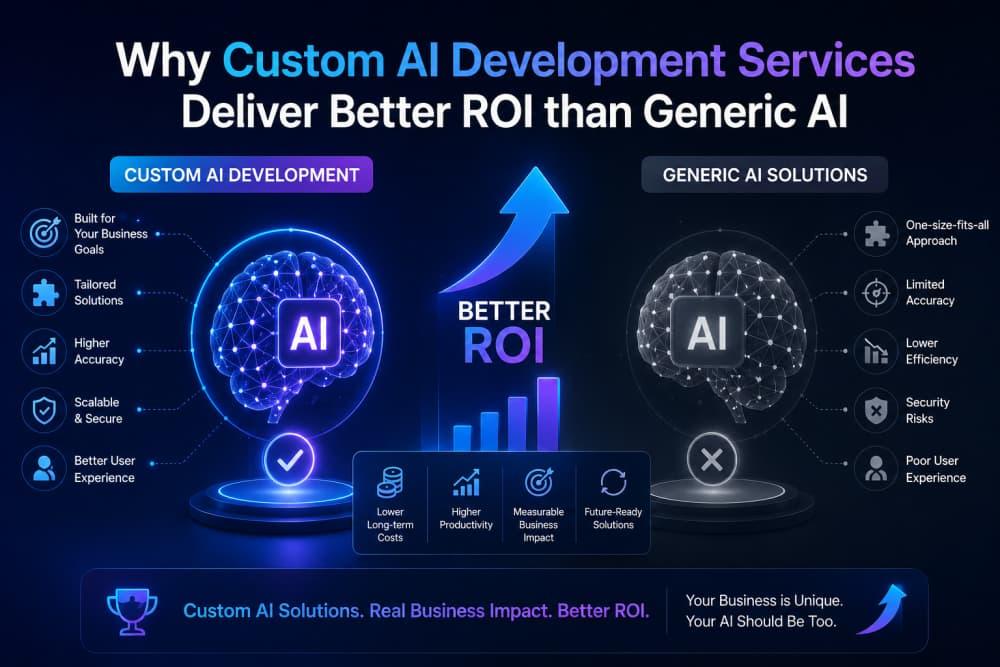
Businesses are starting to realize that generic AI platforms often deliver quick wins on the surface while deeper operational problems remain untouched. A chatbot might handle simple questions. A generic AI assistant may produce reports. But real enterprise operations are far more complicated than that.
Most businesses run on messy workflows, old systems, disconnected data, compliance pressures, and processes that are unique to their industry. Those realities cannot be copied from one company to another.
That is where tailored artificial intelligence development services start delivering real business value.
Generic AI Often Solves Broad Problems, Not Business-Specific Ones
Most off-the-shelf AI tools are designed for scale. Vendors build them to serve thousands of companies at once. That sounds efficient until businesses try fitting those tools into highly specific operational environments.
Then reality kicks in.
- The software handles common tasks but struggles with company-specific workflows.
- Teams create workarounds.
- Employees lose trust in outputs.
- Departments return to spreadsheets and manual reviews because the AI feels unreliable.
This happens more often than vendors admit.
Consider a few examples:
A retail company, for example, may need AI that understands seasonal buying behavior across regions.
A logistics firm may require models trained on delivery exceptions and warehouse delays.
A healthcare provider may need systems built around clinical documentation rules.
Generic AI rarely understands that depth. And businesses end up paying for software that only partially works.
That is one reason enterprises increasingly partner with a specialized AI development services provider instead of depending entirely on ready-made platforms.
Custom AI Development Services Create Technology Around the Business
Custom AI flips the model.
Instead of asking teams to adapt to software limitations, businesses develop systems around their own operations. That difference changes the outcome dramatically.
An effective AI development solution is not built around trends or buzzwords. It is built around workflows, customer behavior, operational bottlenecks, and measurable business goals.
The result feels less like “using AI” and more like improving how the business runs every day.
Better Alignment with Existing Processes
One of the biggest problems with generic AI is friction.
Employees already operate inside established systems. They use specific tools, follow approval chains, and manage responsibilities shaped over the years. When AI forces them to change everything overnight, adoption slows immediately.
Custom systems avoid that problem.
An experienced artificial intelligence development services company studies how teams actually work before building the solution. That allows AI to fit naturally into daily operations instead of disrupting them.
The impact is significant:
- Employees are more likely to trust and use tools that feel connected to their environment.
- Higher adoption usually leads to stronger ROI.
Custom AI doesn’t just add intelligence; it integrates seamlessly into the way the business already runs.
Stronger Data Utilization
Most enterprises already sit on enormous amounts of internal data:
- Customer interactions
- Operational metrics
- Support tickets
- Financial records
- Supply chain information
But raw data alone does not create value.
Custom AI systems are trained to interpret business-specific datasets in ways that generic models cannot. That gives organizations more relevant outputs and better decision-making support.
- A generic AI assistant might summarize information.
- A tailored AI system can identify patterns tied directly to revenue leakage, customer churn, or operational inefficiencies.
That difference matters financially. Custom AI doesn’t just process data; it transforms it into insights that directly impact the bottom line.
Why ROI Improves Faster with Custom AI
Many companies assume generic AI is cheaper because the upfront price looks lower. But that number rarely reflects the real cost.
Businesses often spend months trying to make generic platforms fit workflows they were never built for. Integration expenses climb, productivity slows, and teams end up double-checking outputs more than expected. Over time, those hidden costs quietly add up.
Research shows that while global AI spending keeps rising, many organizations still struggle to achieve consistent returns because implementation complexity slows adoption and scalability.
Custom AI helps reduce those problems early because it is built around actual business goals from the start.
There is less friction between teams and technology, fewer workflow adjustments, and smoother integrations. That usually leads to faster, more measurable results.
Artificial Intelligence Development Services Help Businesses Scale More Smoothly
AI pilots are easy. Scaling them is the difficult part.
A proof-of-concept may work perfectly inside one department with clean datasets and limited users. But enterprise environments are rarely controlled or predictable.
- Data structures evolve.
- Customer expectations shift.
- Regulations change.
- Internal processes expand.
Generic systems often struggle under that pressure because they were not built for the organization’s long-term operational reality.
Custom AI systems are usually designed with scalability in mind from the beginning.
That includes:
- Flexible architecture
- Role-based access controls
- API-level integrations
- Continuous model retraining
- Governance frameworks
- Industry-specific compliance support
These details may not sound exciting during a sales presentation. But they matter enormously later, especially when AI becomes tied to revenue operations, customer service, forecasting, or risk management.
The Best AI Development Solution Is Usually the One Employees Barely Notice
It may sound counterintuitive, but the most successful enterprise AI systems often work quietly in the background.
They do not force employees to completely change how they work. Instead, they remove friction from existing workflows:
- A support team gets faster ticket categorization.
- A finance department spots anomalies earlier.
- A logistics manager receives smarter route recommendations.
- A sales team gets cleaner forecasting insights.
The AI becomes part of the operation instead of a separate platform that people are forced to learn. That subtle integration is one reason custom AI development services often outperform generic AI in long-term adoption rates.
The technology feels practical instead of experimental. And when employees trust and use the tools naturally, adoption rises, and ROI strengthens.
Businesses Are Becoming More Selective About AI Investments
Companies are no longer buying AI software simply because competitors are doing it. Leadership teams want measurable operational improvement. They want systems tied to revenue, efficiency, customer retention, or cost reduction. And they want those outcomes faster.
A report highlighted by Business Insider found that companies experiencing maximum gains from AI generally concentrate on targeted application areas rather than indiscriminate implementation. In some instances, the ROI ratio stood at three times the money invested.
That strategy aligns naturally with custom development.
A specialized artificial intelligence development services company can identify where AI will create the highest operational impact instead of applying automation everywhere at once. That focused approach tends to produce better results and fewer expensive failures.
Conclusion
Generic AI is not useless. For simple tasks and quick experimentation, it can absolutely help businesses move faster. But enterprise ROI rarely comes from surface-level automation alone. It comes from operational alignment.
This is the reason why many firms have started using custom AI development services instead of depending entirely on standardized platforms.
Tailored AI systems integrate more naturally into business operations, adapt more effectively to industry requirements, and deliver outputs employees can trust.
The difference becomes even clearer over time:
- Custom systems scale more smoothly.
- Governance becomes easier to manage.
- Teams adopt the technology faster because it feels connected to their work instead of sitting outside it.
And ultimately, that is what businesses care about. Not AI for the sake of AI, but AI that produces measurable business value.

 English
 Arabic
 French
 Spanish
 Portuguese
 Deutsch
 Turkish
 Dutch
Dutch
 Italiano
 Romaian
 Portuguese (Brazil)
 Greek
Greek
