


Does Your ARP Need a Pistol Brace?
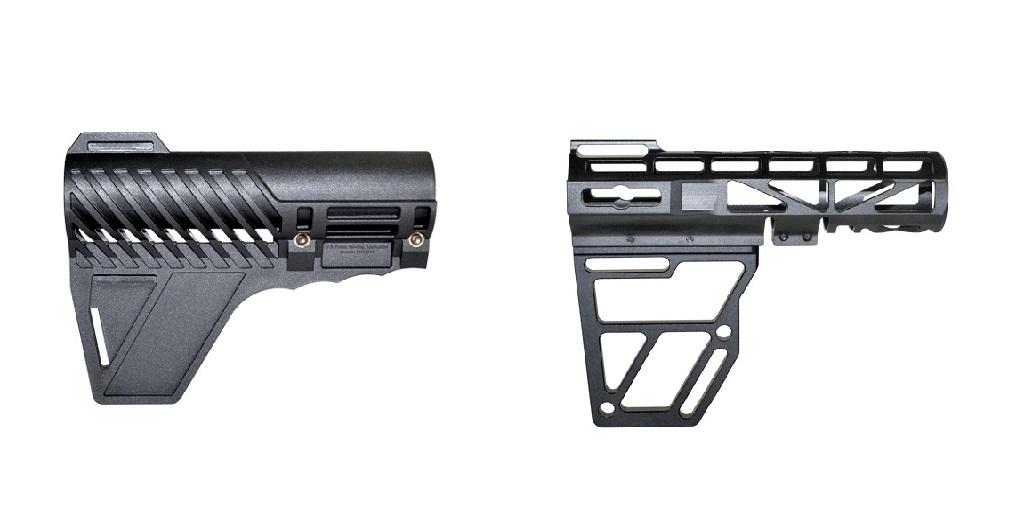
ARP shooters know one thing very well: while you can get rifle-sized firepower from an AR pistol, you don’t just get rifle-sized recoil. You get worse. ARPs are lighter and smaller than their full-sized cousins, and that loss of mass comes at a price.
For some shooters, AR pistols are downright difficult to control.
That being said, one thing you may be able to do is install an AR pistol brace to help control recoil. This short guide is designed to help with that very question.
What Is a Pistol Brace?
An AR pistol brace, at its most basic, is a stabilizing fin that attaches to the buffer tube of an ARP.
It is designed to brace against the inner forearm of a shooter when the ARP is being fired one-handed, hence the name. Some may have straps that wrap around the forearm.
It is important to note that a pistol brace is not a stock, and it is neither large enough to reach to the shoulder, nor intended to do so.
Therefore a pistol brace is effectively just a tool to help stabilize the ARP when the shooter is firing with one hand. It is not intended to convert the ARP into a shoulder-mounted arm.
Many shooters find that AR pistol braces can considerably impact their ability to control recoil, and in a positive way. For this reason, some who build or buy ARPs find pistol braces to be quite valuable and practical shooting accessories.
Of course, that brings up the question of whether or not you need one in your specific case.
Do You Need One?
If you struggle to control recoil when you fire your ARP one-handed, then you might find a pistol brace valuable.
If you don’t, you don’t need it. Not all shooters struggle with recoil from small intermediate cartridges like 5.56, even with an ARP. If you don’t have an issue with recoil just skip it as a brace can make an ARP a little more cumbersome to handle.
Where to Get a Pistol Brace?
If you’re in the market for an AR pistol brace, consider visiting MCS Gearup. They sell a wide variety of pistol braces (in various colors and configurations) in addition to many other AR and AR parts, including assembled uppers, build kits, and shooting attachments of all sorts.
Or You Could Just Train One-Handed
With all of this being said, there are many things you can do to help you control recoil with your ARP. Some of these involve handling and training, and others are more related to adjustments you can make to the platform itself.
Let’s start with the latter. If you need to reduce recoil in an ARP, two things you can do are adjust the buffer weights and install a muzzle brake.
Heavier buffer weights will help absorb some of the force of felt recoil, and ARPs tend to perform better with heavier weights anyway.
As for a muzzle brake, that will change how gasses are vented at the muzzle. A good muzzle brake will not just cut felt recoil by anywhere from 30% to 50%, but it will also help keep muzzle flip down.
Now let’s take a closer look at what you can do from a handling perspective.
One, get a proper grip on the ARP. you want maximum surface area contact between your grip and the gun; and use both hands.
Second, you should bend your knees slightly and lean forward into the shot to help absorb recoil.
Across all of these items, you should be able to help corral recoil, even with a rifle-chambered ARP. Take some time to get to the range and train; it’ll pay off.
For more information about Glock Kits and Micro Roni Glock Please visit: MCS Gearup.

 English
 Arabic
 French
 Spanish
 Deutsch
 Turkish
 Dutch
Dutch
 Italiano
 Russian
 Romaian
 Portuguese (Brazil)
 Greek
Greek
