


Global Tellurium Metal Market to Reach USD 552.8 Million by 2034 as CdTe Solar Panels and Thermoelectric Devices Drive Demand
Tellurium is a brittle, silvery-white metalloid valued for its rare combination of semiconductor, thermoelectric, and metallurgical properties. Although it is used in relatively small volumes compared with industrial metals such as copper, steel, or aluminum, tellurium plays an important role in several advanced technologies where material performance is highly dependent on specialized chemical and electronic behavior.
Unlike many metals that are mined directly, tellurium is primarily recovered as a by-product of copper refining, especially from copper anode slimes. This makes its supply closely connected to copper production rather than direct tellurium demand. As a result, tellurium occupies a unique position in the global critical materials landscape: it is strategically important for solar energy, electronics, and metallurgy, but its availability is constrained by the economics and output of another major metal industry.
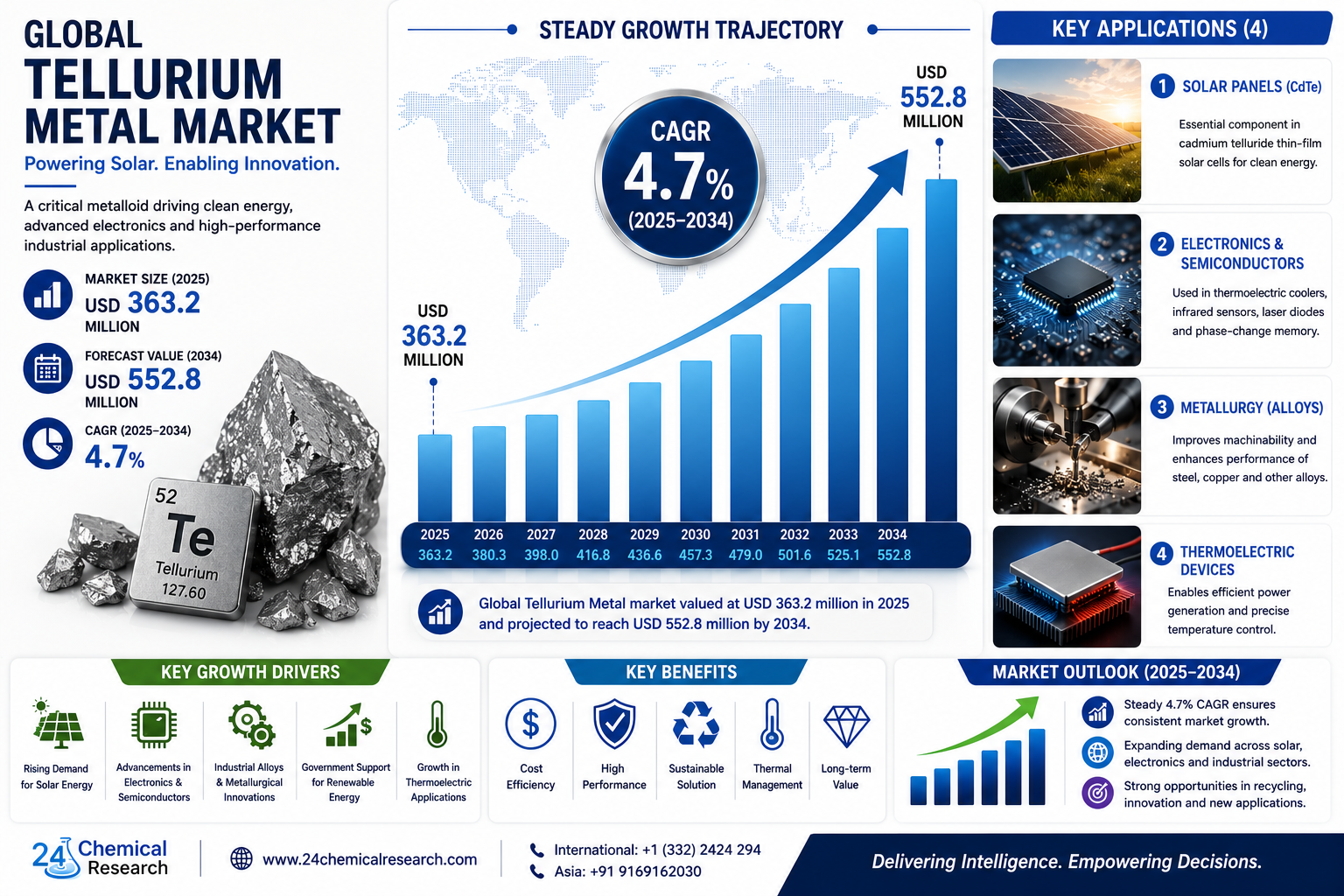
Global Tellurium Metal market was valued at USD 363.2 million in 2025 and is projected to reach USD 552.8 million by 2034, exhibiting a CAGR of 4.7% during the forecast period. The market is being supported by rising demand for cadmium telluride (CdTe) thin-film solar panels, thermoelectric devices, advanced electronics, phase-change memory, infrared sensors, and machinability-enhancing metal alloys.
Get Full Report Here:
https://www.24chemicalresearch.com/reports/307149/tellurium-metal-market
Market Dynamics:
The Tellurium Metal market is shaped by a dynamic combination of renewable energy demand, advanced electronics adoption, metallurgical applications, supply chain limitations, price volatility, and growing interest in recycling and circular economy models. As solar power, high-performance electronics, and thermal management systems expand, tellurium is becoming increasingly relevant across both energy and high-tech manufacturing industries.
Key Market Highlights
● Global Tellurium Metal market was valued at USD 363.2 million in 2025 and is projected to reach USD 552.8 million by 2034.
● The market is expected to grow at a CAGR of 4.7% during the forecast period.
● Cadmium telluride solar panels represent the largest and fastest-growing application segment.
● Tellurium is mainly recovered as a by-product of copper refining, making supply dependent on copper industry output.
● High-purity tellurium grades are gaining demand in semiconductors, thermoelectrics, infrared sensors, and phase-change memory devices.
● Asia-Pacific dominates the global market, supported by China’s copper refining capacity, solar panel production, and electronics manufacturing base.
● Recycling of CdTe solar panels and recovery from secondary sources represents a major long-term opportunity.
Powerful Market Drivers Propelling Expansion
-
Solar Energy Sector Expansion:
The global transition toward renewable energy is the strongest demand driver for the Tellurium Metal market. Tellurium is a key material in cadmium telluride photovoltaic technology, where it serves as an essential component of thin-film solar cells.
CdTe solar panels are widely used in utility-scale solar power projects because they can offer competitive production costs, strong performance in high-temperature environments, and efficient large-area energy generation. These characteristics make CdTe technology particularly attractive for solar farms in high-irradiance regions.
Government policies supporting renewable energy deployment are creating a sustained demand pipeline for solar technologies. Incentives, decarbonization targets, grid-scale clean energy investments, and corporate renewable power commitments are all helping increase demand for photovoltaic materials.
As countries expand solar energy capacity to reduce dependence on fossil fuels, tellurium demand is expected to remain closely tied to CdTe module production. The scalability of CdTe panels in large solar projects further strengthens tellurium’s role as a strategic material for the energy transition.
-
Electronics and Semiconductor Advancements:
The electronics and semiconductor industries are creating rising demand for specialized materials with strong thermal, electrical, and phase-change properties. Tellurium plays an important role in this area through compounds such as bismuth telluride, which is widely used in thermoelectric devices.
Thermoelectric materials can convert heat into electricity or provide precise cooling through solid-state systems. Tellurium-based thermoelectric coolers are used in microprocessors, laser diodes, infrared sensors, optical communication systems, medical devices, and compact electronic assemblies where accurate temperature control is essential.
As electronic devices become smaller, denser, and more powerful, heat management becomes a critical design challenge. Tellurium-based thermoelectric modules help address this need by offering localized cooling without moving parts, making them valuable in applications where reliability and compact design are important.
Tellurium is also used in phase-change memory devices, which are being studied and developed for next-generation data storage technologies. Phase-change materials can switch between amorphous and crystalline states, enabling fast and durable memory performance. This positions tellurium at the intersection of semiconductor innovation, data storage, and advanced computing.
-
Metallurgical Innovations and Alloy Production:
Tellurium has long been valued in metallurgy because small additions can significantly improve the machinability of metals such as steel and copper. In automated manufacturing, improved machinability can reduce tool wear, increase production speed, improve surface finish, and lower overall manufacturing costs.
Tellurium-containing alloys are used in applications where precision machining is important. These include automotive components, industrial machinery parts, electrical connectors, plumbing components, and engineered metal products.
In copper alloys, tellurium improves machinability while helping maintain good electrical and thermal conductivity. This makes tellurium copper useful in electrical and industrial applications where both conductivity and ease of machining are important.
The demand for high-performance, easy-to-machine alloys continues to support steady tellurium consumption. As manufacturers adopt automated machining systems and seek greater production efficiency, tellurium’s role in specialty alloys remains commercially important.
Download FREE Sample Report:
https://www.24chemicalresearch.com/download-sample/307149/tellurium-metal-market
Significant Market Restraints Challenging Adoption
Despite its strategic importance, the Tellurium Metal market must navigate several significant hurdles to achieve broader adoption and long-term supply stability.
-
Supply Chain Constraints and By-Product Dependency:
The most important restraint in the Tellurium Metal market is its dependence on copper refining. Tellurium is primarily recovered from copper anode slimes rather than mined as a primary material. This means supply is determined largely by copper production volumes, copper refinery economics, recovery technologies, and investment decisions within the copper industry.
This by-product dependency creates a structural supply challenge. Even if demand for tellurium rises rapidly due to solar panels or electronics, producers cannot always increase supply quickly unless copper refining output also expands or recovery rates improve.
Geopolitical events, labor strikes, mine disruptions, energy costs, environmental regulations, and economic downturns affecting major copper-producing countries such as Chile, Peru, and China can affect tellurium availability. For end-users that require stable long-term supply, this creates procurement risk and planning uncertainty.
The issue is especially important for CdTe solar panel manufacturers, thermoelectric device producers, semiconductor companies, and specialty alloy manufacturers that rely on consistent tellurium feedstock availability.
-
Price Volatility and Economic Sensitivity:
Tellurium prices are often volatile because of the material’s by-product nature, limited supply base, and dependence on demand from a few key applications. Prices can fluctuate sharply based on copper market dynamics, speculative trading, solar sector demand, electronics demand, and supply disruptions.
This volatility creates difficulties for manufacturers that use tellurium in commercial technologies. Solar panel producers, electronics manufacturers, and alloy producers must manage input cost uncertainty while also meeting customer pricing expectations.
Price instability can also discourage investment in tellurium-dependent technologies. Some companies may prefer alternative materials with more stable supply chains, even if those alternatives offer lower performance in specific applications.
For the Tellurium Metal market to expand more sustainably, improving supply transparency, increasing recovery efficiency, and developing secondary sources through recycling will be essential.
Critical Market Challenges Requiring Innovation
Beyond supply constraints and pricing pressure, the Tellurium Metal market faces technical, commercial, and regulatory challenges that require continuous innovation.
Scaling tellurium production is complicated by the complex extraction and purification processes needed to recover high-purity tellurium from copper refinery by-products. These processes require specialized infrastructure, chemical expertise, quality control, and capital investment.
High-purity tellurium is especially important for semiconductors, thermoelectrics, infrared sensors, and phase-change memory applications. In these industries, even trace impurities can affect material performance, device efficiency, and production yield. This creates a need for advanced refining and purification capabilities.
Tellurium’s largest growth application, CdTe solar panels, also faces competition from crystalline silicon technology. Silicon-based photovoltaic modules continue to dominate the global solar market and benefit from large-scale production, continuous efficiency improvements, and strong supply chain maturity.
To increase market share, CdTe technology must continue demonstrating advantages in cost, scalability, temperature performance, and sustainability. Tellurium producers and CdTe manufacturers must work together to ensure material availability and improve long-term supply security.
Health, safety, and environmental regulations also affect tellurium compounds. While tellurium metal itself is used in controlled industrial settings, certain tellurium compounds require careful handling and compliance procedures. This adds operational complexity and cost for producers and end-users.
Vast Market Opportunities on the Horizon
-
Recycling and Circular Economy Models:
Recycling represents one of the most important long-term opportunities for the Tellurium Metal market. As the installed base of CdTe solar panels grows, a significant end-of-life material stream is being created. This provides an opportunity to recover high-purity tellurium from used solar modules.
Developing efficient recycling infrastructure can reduce dependence on primary copper refining, improve supply security, and lower environmental impact. A circular economy approach would allow tellurium to be recovered, refined, and reused in new photovoltaic modules or other high-value applications.
Solar panel recycling is likely to become more important as early generations of CdTe panels reach the end of their service life. Companies that develop cost-effective recovery processes and closed-loop supply systems may gain a major competitive advantage.
Recycling also aligns with global sustainability objectives. Renewable energy technologies are increasingly evaluated not only on power generation performance but also on material sourcing, lifecycle impact, and recyclability. Tellurium recovery can strengthen the sustainability profile of CdTe solar technology.
-
Exploration of Primary Deposits and Novel Applications:
Current supply constraints are encouraging investment in new sources of tellurium. Although tellurium is mainly recovered as a by-product, rare dedicated tellurium deposits and tellurium-rich mineral resources are being evaluated in selected regions.
Advances in hydrometallurgy, bioleaching, and improved recovery technologies could increase tellurium extraction from existing ores and refinery streams. These innovations may make new sources economically viable and reduce the market’s dependence on conventional copper refining.
Beyond current applications, ongoing research into tellurium’s properties is creating opportunities in advanced infrared optics, radiation detection, next-generation semiconductors, data storage, and selected biomedical research areas.
Novel tellurium-based compounds may support future technologies where thermal control, optical response, radiation sensitivity, or phase-change behavior are critical. While many of these applications remain at research or early commercialization stages, they could unlock new demand streams over the long term.
-
Strategic Vertical Integration and Partnerships:
The Tellurium Metal market is increasingly moving toward strategic partnerships and vertical integration. Because supply is limited and demand is concentrated in high-value applications, collaboration across the value chain is becoming essential.
Partnerships between tellurium producers, copper refiners, solar panel manufacturers, electronics companies, and advanced materials suppliers can help secure supply, improve material specifications, and reduce procurement risk.
For solar panel manufacturers, long-term tellurium supply agreements are important because CdTe production depends on consistent material availability. For electronics and semiconductor customers, purity, reliability, and technical support are critical.
Vertical integration can also improve supply chain resilience. Companies that control or closely coordinate copper refining, tellurium recovery, purification, and customer supply are better positioned to manage market volatility and deliver consistent quality.
These collaborations can reduce time-to-market for new technologies and support application-specific innovation in solar panels, thermoelectric modules, sensors, and memory devices.
In-Depth Segment Analysis: Where is the Growth Concentrated?
By Type:
The market is segmented by purity levels into:
● ≥99%
● ≥99.9%
● ≥99.99%
● ≥99.999%
● ≥99.9999%
● Others
High-Purity Grades, especially ≥99.99% and above, are experiencing accelerated growth. These grades are required in semiconductors, advanced electronics, thermoelectric modules, infrared sensors, and phase-change memory devices where even trace impurities can affect device performance and yield.
The ≥99% purity grade continues to dominate volume consumption because it is widely used in metallurgical applications. This grade is suitable for alloying, machinability enhancement, and other industrial uses where ultra-high purity is not required.
Grades such as ≥99.999% and ≥99.9999% command premium pricing because they require advanced purification and strict quality control. Demand for these ultra-high purity grades is expected to grow as electronics, semiconductor, and advanced thermoelectric applications expand.
By Application:
Application segments include:
● Solar Panels (CdTe)
● Metallurgy (Alloys)
● Thermoelectrics
● Others
Solar Panels represent the largest and fastest-growing application segment. CdTe photovoltaic technology uses tellurium as a core material, and global investment in renewable energy infrastructure continues to support demand. Utility-scale solar projects remain a major demand source because CdTe panels are well suited for large-scale power generation in high-temperature and high-irradiance regions.
Metallurgy remains a stable and significant application area. Tellurium is used in steel, copper, and other alloys to improve machinability, reduce tool wear, and support efficient industrial production.
Thermoelectrics are emerging as an important growth segment. Tellurium-based thermoelectric materials, especially bismuth telluride compounds, are used for precision cooling and waste heat recovery. Demand is supported by electronics, industrial equipment, automotive systems, laser devices, and medical technologies.
Other applications include phase-change memory, infrared sensors, radiation detection, specialty chemicals, and advanced research materials. These applications may represent smaller volumes but can offer higher value because of strict purity and performance requirements.
By End-User Industry:
The end-user landscape includes:
● Energy (Solar)
● Electronics
● Industrial Manufacturing
● Others
The Energy sector accounts for the largest share of the Tellurium Metal market due to CdTe solar panel production. As countries expand renewable energy infrastructure, demand from solar panel manufacturers is expected to remain the primary growth driver.
The Electronics industry is a rapidly expanding end-user segment. Tellurium is used in thermoelectric modules, phase-change memory, infrared sensors, semiconductors, and thermal management devices. As electronic devices become more compact and performance-intensive, demand for tellurium-based components may increase.
Industrial Manufacturing continues to consume tellurium for alloy production. Tellurium improves machinability in metals, helping manufacturers increase productivity and reduce tooling costs.
Other end-use areas include aerospace, defense, research institutions, medical technology, and advanced materials development. These sectors may consume lower volumes but often require higher-purity grades and specialized material performance.
Download FREE Sample Report:
https://www.24chemicalresearch.com/download-sample/307149/tellurium-metal-market
Frequently Asked Questions
What is tellurium metal used for?
Tellurium metal is used in cadmium telluride solar panels, thermoelectric devices, metal alloys, semiconductors, infrared sensors, phase-change memory, and specialty materials. Its semiconductor, thermoelectric, and metallurgical properties make it valuable in renewable energy, electronics, thermal management, and industrial manufacturing applications.
What is driving the Tellurium Metal market?
The Tellurium Metal market is driven by rising demand for CdTe thin-film solar panels, thermoelectric cooling devices, semiconductor materials, phase-change memory, and machinability-enhancing alloys. Renewable energy expansion and advanced electronics manufacturing are the most important long-term growth drivers.
Why is tellurium supply constrained?
Tellurium supply is constrained because it is mainly recovered as a by-product of copper refining. Its availability depends on copper production volumes, refinery recovery rates, and copper market economics rather than direct tellurium demand. This creates supply uncertainty and price volatility.
Which application dominates the Tellurium Metal market?
Solar Panels, especially cadmium telluride thin-film solar panels, dominate the Tellurium Metal market. CdTe photovoltaic technology uses tellurium as a key material and benefits from rising investment in utility-scale solar power, renewable energy deployment, and clean energy infrastructure.
Which region leads the Tellurium Metal market?
Asia-Pacific leads the global Tellurium Metal market, supported by China’s copper refining capacity, solar panel manufacturing, and electronics production. Japan and South Korea also contribute strong demand for high-purity tellurium used in semiconductors, thermoelectrics, and advanced electronics.
Competitive Landscape:
The global Tellurium Metal market is semi-consolidated, featuring a mix of major mining companies, specialized metal refiners, and niche chemical producers. The competitive environment is shaped by access to copper refining streams, tellurium recovery capabilities, purification technology, product purity, supply reliability, and long-term customer relationships.
Key players often compete based on product quality, consistent supply, technical customer support, and the ability to deliver high-purity grades for demanding applications. As solar, electronics, and thermoelectric demand grows, companies with reliable feedstock access and advanced purification capabilities are likely to strengthen their market positions.
List of Key Tellurium Metal Companies Profiled:
● 5N Plus (Canada)
● Aurubis AG (Germany)
● JX Nippon Mining & Metals Corporation (Japan)
● Zhuzhou Keneng New Material Co., Ltd. (China)
● Umicore (Belgium)
● Teck Resources Limited (Canada)
● Vital Materials Co., Ltd. (China)
● Nippon Rare Metal, Inc. (Japan)
● American Elements (U.S.)
● Materion Corporation (U.S.)
The strategic focus for leading players includes investment in research and development, production efficiency, tellurium recovery improvement, purification technology, and quality control. Companies are also forming long-term partnerships with end-users in solar energy, electronics, and advanced materials to improve supply security and support application-specific innovation.
Securing raw material sources is especially important because tellurium supply depends heavily on copper refining. Companies connected to copper refining operations or with strong secondary recovery capabilities may hold a competitive advantage.
As recycling becomes more important, producers that can recover tellurium from end-of-life CdTe solar panels and industrial residues may create additional supply streams and reduce exposure to primary supply volatility.
Regional Analysis: A Global Footprint with Distinct Leaders
● Asia-Pacific:
Asia-Pacific is the dominant force in the global Tellurium Metal market, commanding a significant majority share. The region’s leadership is driven by China’s large copper refining capacity, which provides a major source of tellurium supply.
China also represents one of the largest demand centers because of its strong solar panel manufacturing industry, electronics production base, and advanced materials ecosystem. The country’s role in both supply and consumption makes it central to the global tellurium value chain.
Japan and South Korea contribute significantly through high-purity tellurium demand from electronics, semiconductors, thermoelectric devices, infrared sensors, and advanced manufacturing sectors. These countries require consistent, high-quality tellurium for specialized technologies where purity and performance are critical.
Asia-Pacific’s combination of copper refining, solar manufacturing, and electronics production gives the region a strong structural advantage in the Tellurium Metal market.
● North America:
North America holds a significant position as both a producer and consumer of tellurium metal. The region benefits from companies such as 5N Plus and Teck Resources, along with strong demand from solar energy, electronics, advanced materials, and high-tech manufacturing sectors.
The United States and Canada are increasingly focused on renewable energy deployment and domestic supply chain security for critical materials. These priorities support interest in tellurium supply stability, recycling, and value-added processing.
North America’s solar sector creates demand for CdTe photovoltaic materials, while its electronics and advanced manufacturing industries support demand for high-purity tellurium used in thermoelectrics, sensors, and specialty components.
Government initiatives related to clean energy, critical minerals, and domestic manufacturing could further support regional investment in tellurium recovery, recycling, and processing capabilities.
● Europe:
Europe maintains a strong presence in the Tellurium Metal market, led by Germany’s Aurubis, one of the world’s largest copper recyclers and refiners and a major tellurium producer. The region’s demand is supported by renewable energy, high-value manufacturing, electronics, and sustainability-focused material recovery.
Europe’s strong focus on clean energy supports demand for solar technologies, while its advanced industrial base creates demand for tellurium-containing alloys, thermoelectric devices, and specialty materials.
Stringent environmental and recycling regulations in Europe encourage the development of advanced recovery technologies. This makes the region important not only as a consumer but also as a potential leader in tellurium recycling and circular economy models.
European manufacturers increasingly value responsible sourcing, low-impact material recovery, and supply chain transparency. These trends may support long-term investment in tellurium recovery from secondary materials and end-of-life solar panels.
● Rest of the World:
Regions such as South America and the Middle East & Africa primarily contribute to the Tellurium Metal market through their role in copper mining and copper concentrate supply. Since tellurium is mainly recovered from copper refining by-products, upstream copper-producing regions influence global tellurium availability.
South America is particularly important because of major copper-producing countries such as Chile and Peru. While the region currently plays a larger role in upstream copper supply than refined tellurium production, future investment in local refining and by-product recovery could create value-added opportunities.
The Middle East & Africa currently represent smaller demand centers, but future opportunities may emerge through solar energy development, industrialization, and mineral processing investments.
Over time, these regions may gain importance if they expand refining capacity and develop technologies to recover tellurium from copper processing streams locally.
Get Full Report Here:
https://www.24chemicalresearch.com/reports/307149/tellurium-metal-market
Download FREE Sample Report:
https://www.24chemicalresearch.com/download-sample/307149/tellurium-metal-market
Need More In-Depth Market Intelligence?
The complete report provides detailed insights into:
✔ Regional demand forecasts
✔ Production capacity analysis
✔ Pricing trends
✔ Competitive landscape
✔ Supply chain developments
✔ Emerging opportunities
✔ Purity-grade demand analysis
✔ Application-wise growth outlook
✔ Recycling and circular economy trends
Access the Full Report:
https://www.24chemicalresearch.com/reports/307149/tellurium-metal-market
About 24chemicalresearch
Founded in 2015, 24chemicalresearch has rapidly established itself as a trusted provider of chemical market intelligence, serving clients including over 30 Fortune 500 companies. The company provides data-driven insights through rigorous research methodologies, helping businesses understand government policy, emerging technologies, competitive landscapes, production capacity, pricing movements, and supply chain developments.
● Plant-level capacity tracking
● Real-time price monitoring
● Techno-economic feasibility studies
International: +1(332) 2424 294 | Asia: +91 9169162030

 English
 Arabic
 French
 Spanish
 Portuguese
 Deutsch
 Turkish
 Dutch
Dutch
 Italiano
 Russian
 Portuguese (Brazil)
 Greek
Greek
