


Pumpkin Seed Protein & Fiber Market Forecast 2026 – 2036: Global Market to Reach USD 1,560.0 Million by 2036 at 10.2% CAGR
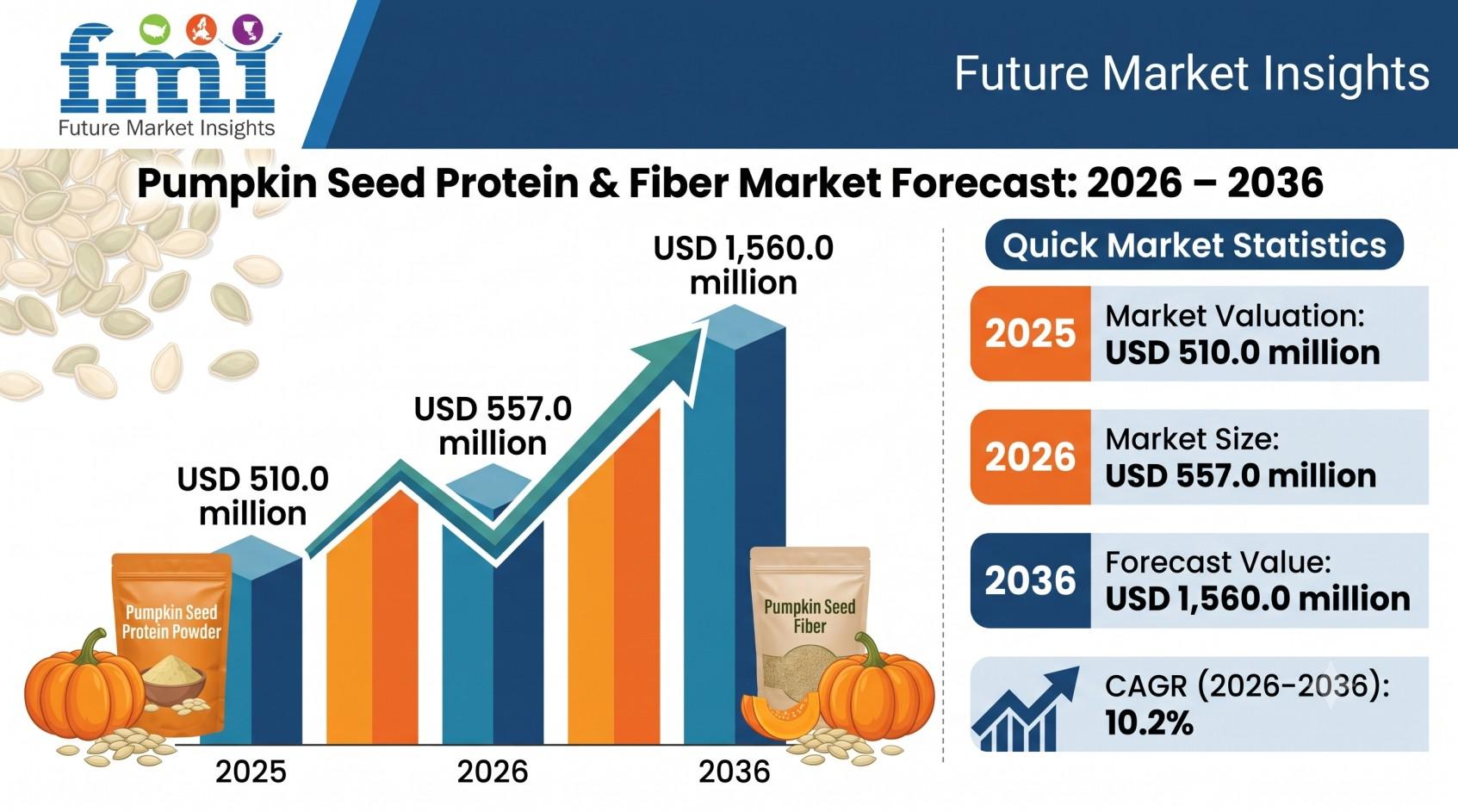
The global pumpkin seed protein and fiber market is entering a phase of rapid, specification-driven expansion as functional food formulators and beverage manufacturers increasingly replace conventional dairy and soy proteins with hypoallergenic, dual-action seed extracts. Valued at USD 510.0 million in 2025 and estimated at USD 557.0 million in 2026, the sector is projected to reach USD 1,560.0 million by 2036, according to the latest research report by Future Market Insights (FMI). The forecast implies a double-digit compound annual growth rate (CAGR) of 10.2% over the ten-year assessment period, unlocking an incremental growth opportunity of USD 1,003.0 million. Value creation is moving away from bulk agricultural byproducts toward refined, high-solubility isolates and standardized dietary fibers that simultaneously satisfy protein enrichment and micronutrient fortification targets.
Quick Market Statistics
· 2025 market valuation: USD 510.0 million
· 2026 market size: USD 557.0 million
· 2036 forecast value: USD 1,560.0 million
· CAGR (2026–2036): 10.2%
· Incremental opportunity: USD 1,003.0 million (USD 1.00 billion)
· Protein concentrate / isolate share of product component (2026): 53.0%
· Powder share of product form (2026): 61.0%
· Food & beverage share of total application volume (2026): ~44.0%
· India market forecast CAGR (2026–2036): 11.9%
· China market forecast CAGR (2026–2036): 11.3%
· United States market forecast CAGR (2026–2036): 10.6%
Request a Sample Report: https://www.futuremarketinsights.com/reports/sample/rep-gb-32130
Market Growth Is Becoming a Dual-Action Functional Nutrition Story
A 10.2% CAGR highlights substantial commercial momentum across the global plant-based and performance nutrition landscape. However, the topline expansion rate reflects an underlying strategic shift in procurement priorities.
Pre-2026 formulations frequently treated seed byproducts as low-cost secondary texturizers. In the 2026–2036 period, food processors and sports nutrition brands are specifying pumpkin seed fractions for their inherent nutritional density naturally providing zinc, magnesium, iron, and complete amino acid profiles alongside dietary fiber. This dual-action positioning enables brands to clean up labels by eliminating synthetic vitamin-mineral premixes and artificial stabilizers. Consequently, procurement managers are entering long-term acreage agreements with agricultural processors to hedge against harvest fluctuations and ensure stable supply lines.
Protein Concentrates and Isolates Lead Component Demand
Protein concentrates and isolates are projected to command 53.0% of the product component segment in 2026, anchoring category value.
This dominance is propelled by advances in cold-pressing and non-thermal separation technologies, which yield high-purity fractions without denaturing protein structures. High-solubility isolates resolve the gritty mouthfeel and vegetal off-notes historically associated with raw seed flours, allowing seamless integration into ready-to-drink (RTD) plant milks, meal-replacement shakes, and functional creamers. In parallel, dietary fiber extracts separated during industrial milling are capturing steady demand from commercial bakers seeking clean-label moisture retention and prebiotic claims.
Powder Form Retains Operational and Logistics Advantages
Dehydrated powder formats are expected to account for 61.0% of total consumption volume in 2026.
Powder remains the standard industrial format due to lower transportation weights, ambient shelf stability, and uniform blending characteristics in commercial dry-mixing equipment. Ingredient processors are investing in advanced jet-milling infrastructure to produce ultra-fine particle distributions. These fine powders disperse rapidly in liquid applications, minimizing phase separation and batch rejection rates for contract manufacturers.
Allergen Avoidance and Clean-Label Reformulation Accelerate Adoption
Escalating consumer sensitivity and stricter regulatory mandates surrounding major food allergens (such as soy, dairy, gluten, and tree nuts) are pushing CPG brands toward hypoallergenic botanical sources. Pumpkin seed protein offers a clean regulatory profile, enabling mass-market brands to formulate universal, allergen-free products without sacrificing essential amino acid counts or protein digestibility scores.
Asia-Pacific Emerges as the Fastest-Growing Processing and Consumption Theater
Geographically, the market presents double-digit expansion across developing Asian powerhouses alongside sustained value-added reformulation in North America and Western Europe.
India leads global demand with an 11.9% CAGR through 2036. Growth is driven by national import-substitution initiatives seeking to replace imported protein isolates with domestic agricultural processing, supported by an expanding middle class seeking accessible preventive nutrition.
China follows closely at an 11.3% CAGR, accelerated by strategic capital investments into domestic plant-protein extraction facilities and expanding functional food integration within modernized retail ecosystems.
Brazil advances at a 9.5% CAGR, leveraging extensive agricultural oilseed infrastructure to process seed meals into export-grade functional ingredients.
Mature Western Markets Prioritize Fiber Mandates and Hypoallergenic Sports Nutrition
North American and European markets remain critical revenue hubs, characterized by high disposable incomes and strict regulatory standards.
The United States is forecast to expand at a 10.6% CAGR through 2036. Growth is anchored by large-scale clean-label reformulation among major CPG conglomerates, high consumer uptake of premium plant-based dairy and functional beverages, and robust domestic pumpkin harvest volumes exceeding 1.4 billion pounds annually.
The United Kingdom is poised to advance at a 10.1% CAGR, driven by public health directives addressing dietary fiber deficits across adult populations, prompting commercial bakers to fortify daily baked goods.
Germany follows at a 9.8% CAGR through 2036, where stringent non-GMO and "Bio" (organic) standards favor cold-pressed botanical fractions over chemically extracted soy isolates.
Competitive Landscape: Processing Tech and Scaled Partnerships Define Leadership
The competitive arena features specialized botanical extraction companies alongside diversified agribusiness groups competing on solubility, neutral sensory attributes, and supply chain security.
Key companies identified in the market include:
· NNB Nutrition
· Nutris
· Simply Good Foods
· Go Raw
· ALOHA
· Burcon NutraScience Corporation
Market participants are actively engaging in capacity expansions, asset acquisitions, and commercial alliances to build dedicated, certified allergen-free milling facilities. Leading processors differentiate through proprietary debittering and micro-milling technologies, enabling them to secure long-term B2B ingredient contracts with multinational food and beverage corporations.
Key Challenges for Industry Participants
· Feedstock Yield Volatility: Weather variability, seasonal harvests, and localized agricultural disruptions can impact raw seed costs and processing margins.
· Capital Intensity of High-Purity Isolation: Establishing advanced fractionation plants to separate protein isolates from fiber fractions requires substantial upfront capex.
· Flavor Masking Requirements: Residual earthy or nutty notes in lower-purity grades require careful formulation balancing in delicate beverage matrices.
Strategic Opportunities Through 2036
· Co-Stream Fiber Monetization: Upgrading dietary fiber streams into standardized gut-health and clean-label bakery texturizers rather than selling them into low-margin animal feed.
· Micro-Milled Beverage Isolates: Commercializing ultra-soluble, neutral-tasting isolates tailored for plant-based RTD lattes, creamers, and protein waters.
· Single-Origin and Organic Certification: Securing traceable, regenerative agriculture accreditations to capture premium pricing among eco-conscious Western brands.
· Combined Macro-Nutrient Blends: Formulating turnkey, pre-blended pumpkin protein and fiber solutions designed to streamline manufacturing for functional snack bars.
What the Market Means for C-Level Decision-Makers
For food and beverage leadership, pumpkin seed protein and fiber have evolved from niche vegan alternatives into frontline functional tools for clean-label compliance and allergen risk mitigation. Sustainable value creation will depend on securing multi-year upstream supply contracts, investing in precision milling to optimize sensory performance, and marketing dual-action micronutrient benefits.
Exclusive Discounts on Full Report: https://www.futuremarketinsights.com/reports/pumpkin-seed-protein-and-fiber-market
Executive Takeaways
· The global pumpkin seed protein & fiber market is forecast to grow from USD 557.0 million in 2026 to USD 1,560.0 million by 2036.
· At a 10.2% CAGR, the sector represents one of the fastest-growing niches within the broader plant-based ingredients space.
· Protein concentrates and isolates hold a 53.0% share of the component category in 2026, driven by liquid beverage demands.
· Powder formats dominate delivery with a 61.0% volume share in 2026 due to handling and freight efficiencies.
· India (11.9% CAGR) and China (11.3% CAGR) represent the fastest-growing national markets over the forecast horizon.
· Clean-label replacement of soy/dairy and natural micronutrient density remain primary commercial adoption drivers.
Explore More Related Studies Published by FMI Research
Pumpkin Seed Protein Market: https://www.futuremarketinsights.com/reports/pumpkin-seed-protein-market
Linseed (Flax) Protein Isolate Market: https://www.futuremarketinsights.com/reports/linseed-flax-protein-isolate-market
Watermelon Seed Protein Market: https://www.futuremarketinsights.com/reports/watermelon-seed-protein-market
About Future Market Insights (FMI)
Future Market Insights (FMI) delivers actionable, decision-focused market intelligence that goes beyond traditional research reports.
The company provides:
· In-depth pricing and cost benchmarking analysis
· Demand forecasting based on real industry inputs
· Procurement and buyer behavior insights
· Supply chain and trade flow intelligence
· Technology and application trend analysis across industries
FMI follows a robust bottom-up research methodology, combining insights from industry experts, procurement leaders, manufacturers, and technical professionals to ensure accurate and practical market intelligence.
For Press & Corporate Inquiries
Rahul Singh, AVP - Marketing and Growth Strategy
Future Market Insights,
Inc. +1-347-918-3531
For Sales: sales@futuremarketinsights.com
For Media: Rahul.singh@futuremarketinsights.com

 English
 Arabic
 French
 Spanish
 Portuguese
 Deutsch
 Turkish
 Dutch
Dutch
 Italiano
 Russian
 Romaian
 Greek
Greek
