


Your Washers Are Keeping Up—But Is Your Industrial Tumble Dryer Slowing Down Your Laundry?
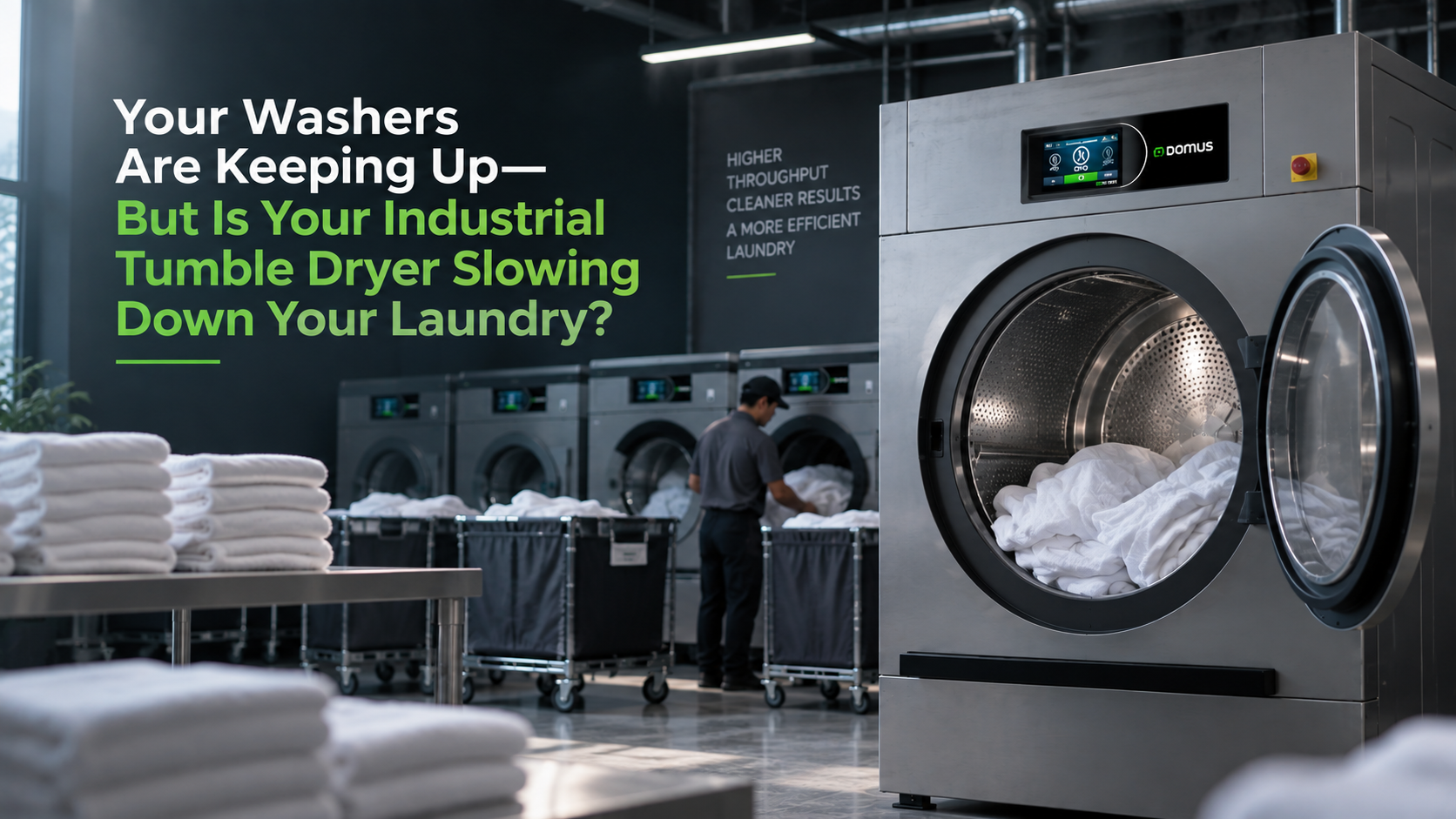
Your washers finish on time, but wet linen keeps waiting for the dryer. If this happens regularly, adding more washing capacity may not improve your output—the real bottleneck could be your industrial tumble dryer. Before investing in another machine, you need to understand drying volume, textile mix, operating hours, and how well your washing and drying capacities work together.
How Do You Know Your Industrial Tumble Dryer Is the Bottleneck?
In a commercial laundry, increasing washing speed only helps when the next stage can handle the output.
Consider this workflow:
Sorting → Washing → Drying → Finishing → Packing → Dispatch
If washed linen regularly waits between washing and drying, your industrial laundry dryer deserves closer attention.
Common warning signs include:
-
Wet loads regularly waiting for dryer availability
-
Washers sitting idle because there is nowhere to send finished loads
-
Dryers operating longer hours than washers
-
Staff extending shifts to complete drying
-
Turnaround getting slower during peak periods
-
Urgent orders disrupting the entire drying schedule
-
Different textile categories competing for dryer time
-
Increasing orders without enough spare drying capacity
However, one busy day does not automatically justify another dryer.
Track the problem over several weeks. Compare daily washed KG, drying loads, operating hours, waiting time, and peak demand. If the drying section consistently restricts overall laundry processing capacity, additional dryer capacity may be worth evaluating.
The important question isn't:
“Is my dryer busy?”
It is:
“Is drying preventing the rest of my laundry from processing more profitable volume?”
How Much Industrial Tumble Dryer Capacity Does Your Laundry Actually Need?
Choosing an industrial tumble dryer machine should start with your actual laundry operation—not simply the capacity printed on your washer.
Begin by recording:
-
Daily laundry volume
-
Wet loads requiring tumble drying
-
Textile categories
-
Practical dryer load sizes
-
Drying programs
-
Available operating hours
-
Peak-day requirements
-
Expected future customer volume
Not everything entering the washing section necessarily follows an identical drying process. Different textiles can have different moisture levels and drying requirements.
A useful planning calculation is:
Required Dryer Loads Per Day = Daily Volume Requiring Tumble Drying ÷ Practical Average Dryer Load
For example, suppose 360 KG of laundry needs tumble drying each day and your practical average dryer load is 30 KG:
360 ÷ 30 = 12 dryer loads per day
This is an illustrative example, not a recommendation for a particular laundry dryer capacity.
You then need to determine whether those loads can realistically be completed within available operating hours.
What size industrial tumble dryer do I need?
There is no universal answer based only on daily KG.
Your required industrial dryer capacity depends on factors such as:
Daily Drying Volume → Textile Mix → Practical Load Size → Drying Cycles → Operating Hours → Peak Demand
A hotel linen operation dominated by towels and bed linen can have a different drying pattern from a laundry handling uniforms, garments, towels, and multiple customer categories.
Instead of asking only, “What KG dryer should I buy?” ask:
“How many practical drying loads must we complete within our available production hours?”
That gives you a stronger basis for selecting a dryer for commercial laundry operations.
Should Industrial Tumble Dryer Capacity Match Washing Machine Capacity?
Not automatically.
It may seem logical that a 30 KG washer should always be paired with a 30 KG dryer. But washer and dryer ratings should not be treated as a universal 1:1 capacity rule.
Drying requirements are affected by:
-
Type of textile
-
Amount of moisture remaining after extraction
-
Dryer loading requirements
-
Drying program
-
Required final moisture level
-
Available drying time
-
Number of washer loads arriving at the drying section
For example, if several washer loads finish within a short period, the dryer must be able to absorb that flow without creating a queue.
This is why your focus should be on throughput, not simply matching numbers printed on two machines.
A useful operating principle is:
Required Washing Throughput ≈ Required Downstream Drying Throughput
That does not mean the washer and dryer must have identical KG ratings or that every laundry needs the same number of washers and dryers.
Instead, evaluate how much laundry leaves the washing section and how quickly the drying section needs to process it.
Why is my commercial laundry drying slower than washing?
If washing consistently finishes faster than drying, investigate the complete process before purchasing equipment.
Possible causes include:
-
Insufficient dryer capacity
-
Too few available dryers
-
Textile-specific drying requirements
-
Poor scheduling between washing and drying
-
Excessive moisture entering the dryer
-
Utility or airflow-related issues
-
Operational practices affecting drying time
The cause should be identified before assuming another commercial tumble dryer is the only solution.
One Large Industrial Dryer or Multiple Tumble Dryers—Which Makes More Sense?
Once you confirm a drying-capacity shortage, you need to decide how to add capacity.
There is no universal winner.
One larger heavy-duty tumble dryer
A larger machine may make sense when your laundry regularly handles suitable bulk loads and has enough volume to use the capacity effectively.
It can potentially reduce the number of individual loads required for suitable textiles.
However, relying heavily on one large dryer can reduce flexibility if your operation frequently needs to process several smaller or segregated loads.
Multiple commercial dryers
Multiple dryers can provide greater flexibility when your business handles different:
-
Customers
-
Textile categories
-
Load sizes
-
Drying programs
-
Turnaround priorities
For example, one commercial laundry dryer could process a bulk towel load while another handles a smaller urgent order.
Multiple machines can also reduce operational dependence on a single drying unit.
But adding machines also affects space, utilities, installation, maintenance, and total investment.
The decision should follow:
Customer Mix → Daily Drying KG → Load Mix → Existing Dryer Capacity → Capacity Gap → Expansion Option
If your laundry is growing, consider expected future demand—but avoid purchasing substantially more capacity than your operation can realistically use.
Internal Link Placeholder: Commercial Washer and Dryer Capacity Guide
What Should You Calculate Before Buying Another Industrial Tumble Dryer?
When researching industrial tumble dryer price in India, the machine quotation is only one part of the investment.
Use:
Total Dryer Expansion Cost = Machine + Installation + Utility Requirements + Site Preparation + Supporting Requirements
The exact requirements depend on the selected machine and your existing facility.
Heating source
Industrial dryers may be available with different heating configurations depending on the model. Evaluate the applicable option against your facility, utilities, operating requirements, and manufacturer specifications.
Available utilities
Check the specific machine's electrical, exhaust, ventilation, and other relevant installation requirements before purchasing.
Space
Allow for more than the physical footprint of the industrial dryer machine. Loading, unloading, linen movement, service access, and workflow also need adequate room.
Operating cost
Purchase price alone does not determine the economics of a dryer.
A useful measurement is:
Drying Cost Per KG = Relevant Drying Operating Cost ÷ Total KG Dried
Tracking this over time helps you understand what drying contributes to your overall laundry processing cost.
Future washing capacity
If you are planning a wider laundry business expansion, consider whether your washer capacity is also expected to increase.
Buying a dryer only for today's washing output could create another capacity problem after the next expansion.
The stronger sequence is:
Current Volume → Future Volume → Washing Throughput → Drying Requirement → Capacity Gap → Equipment Investment
How Orgaearth Can Help Plan Your Laundry Drying Capacity
Orgaearth can help commercial laundry businesses evaluate industrial tumble dryer requirements according to processing volume, textile mix, practical loads, operating hours, existing washing capacity, space, utilities, and future expansion plans.
Instead of considering a commercial dryer machine in isolation, the overall workflow can be reviewed across washing, drying, finishing, and supporting commercial laundry equipment. This helps identify whether additional drying capacity is actually required and what type of equipment best fits the operation.
FAQs About Industrial Tumble Dryers
What size industrial tumble dryer do I need?
Start with the daily KG that actually requires tumble drying, then consider practical load size, textile mix, drying cycles, operating hours, and peak demand. Do not select capacity using daily KG alone.
Should washer and dryer capacity be the same?
Not necessarily. Washing and drying capacity should be planned around practical throughput rather than assuming identical machine KG ratings.
How many dryers does a commercial laundry need?
The number depends on daily drying volume, dryer capacity, operating hours, textile segregation, turnaround requirements, and the number and output of your washers.
What is the industrial tumble dryer price in India?
Pricing varies by capacity, heating configuration, specifications, manufacturer, and installation requirements. Calculate the complete installation and operating requirements rather than comparing machine prices alone.
When should I add another commercial dryer?
Consider additional drying capacity when wet loads consistently wait, dryers regularly operate near their practical production limit, turnaround suffers, and drying has been confirmed as the actual bottleneck.
Contact Us
Orgaearth Laundry Solutions
Plot no. 774, Udyog Vihar, Phase 5, Gurugram, Haryana, India-122016
Email: marketing@orgaearth.com
Contact No.- +91 7042912777

 English
 Arabic
 French
 Portuguese
 Deutsch
 Turkish
 Dutch
Dutch
 Italiano
 Russian
 Romaian
 Portuguese (Brazil)
 Greek
Greek
