


Diamond Carat vs. Clarity - Where to Actually Spend Your Budget
Most first-time diamond buyers ask about carat first and clarity second, if at all. It makes sense—carat is the easiest number to compare, and clarity grades like VS1 or SI2 sound like a foreign language. But these two factors interact more than people realize, and understanding that relationship can save you real money without costing you any sparkle.
Carat: Weight, Not Size
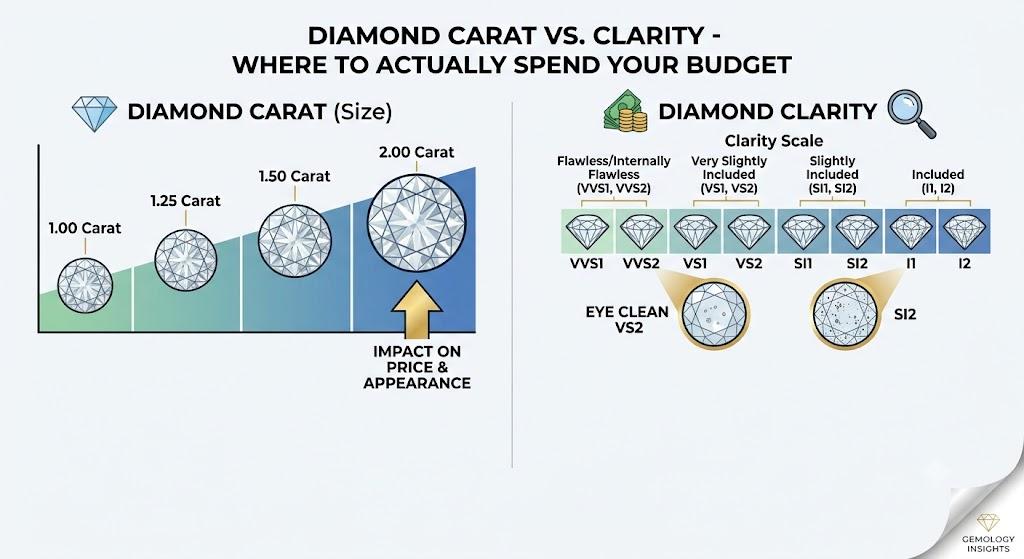
Carat measures a diamond's weight, not how big it looks. One carat equals 200 milligrams, and as weight goes up, so does rarity—which is why price doesn't scale in a straight line. The jump from a 1-carat to a 2-carat diamond isn't just double the price; it can be several times more, since larger high-quality rough stones are harder to find.
Here's the part most buyers miss: two diamonds of the same carat weight can look noticeably different in size depending on their cut and shape. An oval or pear-cut stone often appears larger than a round one of identical weight, simply because of how the shape spreads the weight out. So carat alone doesn't tell you how big a diamond will actually look on the hand.
A practical trick worth knowing — a diamond just under a popular size marker, like 0.90 carats instead of 1.00, can look nearly identical while costing noticeably less. That gap exists purely because of how buyers cluster around round numbers, not because of any real visual difference.
Our full breakdown of carat pricing by size, plus which carat ranges suit which jewelry styles, is covered here: Diamond Carat Guide.
Clarity: Imperfections You'll Probably Never See
Clarity measures how many internal inclusions or surface blemishes a diamond has. The scale runs from FL (flawless) down through IF, VVS, VS, SI, and I grades, with fewer imperfections meaning a higher grade and, usually, a higher price.
Here's the good news: most inclusions at the VS and even SI grades are microscopic and invisible to the naked eye. A diamond doesn't need to be flawless to look flawless while you're wearing it. What jewelers call an "eye-clean" diamond—one where you can't spot any imperfections without magnification—is often available well below the price of a truly flawless stone.
In fact, cut quality has a much bigger impact on how much a diamond sparkles than clarity does. A well-cut VS diamond will often outshine a poorly cut flawless one. That's an easy trap to fall into: paying a premium for a clarity grade that offers no visible benefit, while underspending on the cut that actually determines the brilliance you notice every day.
For the full grading scale, what each clarity level actually looks like, and how natural diamonds compare to lab-grown ones on this front, see our complete guide: Diamond Clarity Guide.
So Where Should Your Budget Actually Go?
If you're working with a fixed budget, here's the general order of priority that gets you the most visible beauty for your money:
-
Cut first. It has the single biggest impact on sparkle, regardless of carat or clarity.
-
Clarity at VS1, VS2, or SI1. These grades are almost always eye-clean and cost meaningfully less than flawless stones.
-
Carat-sized smartly. Consider shapes like ovals or pears that read larger, or sizes just under round-number thresholds, to stretch your budget further.
None of the 4Cs work in isolation—a large, flawless diamond with a poor cut can still look lifeless, while a smaller, well-cut, eye-clean stone can look stunning. The goal isn't maximizing any single number. It's finding the balance that makes the diamond look its best in the setting you've chosen.
Final Thoughts
Carat gives a diamond its presence, and clarity gives you peace of mind that nothing is visibly off—but neither one should dictate your budget on its own. Spend where it actually shows: on the cut and on a clarity grade that reads clean to the eye, and let carat size flex around what's left. That's how you end up with a diamond that looks every bit as impressive as one that cost far more.

 Arabic
 French
 Spanish
 Portuguese
 Deutsch
 Turkish
 Dutch
Dutch
 Italiano
 Russian
 Romaian
 Portuguese (Brazil)
 Greek
Greek
