


Electrical Bushing Market: The Quiet Technology Supporting the Global Electrification Boom
An electrical bushing is a specialized insulating component that allows a live electrical conductor to pass safely through a grounded barrier without creating an electrical path to the surrounding metal enclosure. Bushings are commonly used in transformers, switchgear, substations, and other high-voltage equipment. Although relatively small compared with the systems they serve, they perform a critical safety function: they maintain electrical insulation while allowing power to move between internal and external circuits. As utilities expand, modernize, and replace aging electrical infrastructure, the need for dependable bushing technology continues to rise.
Market Size and Growth
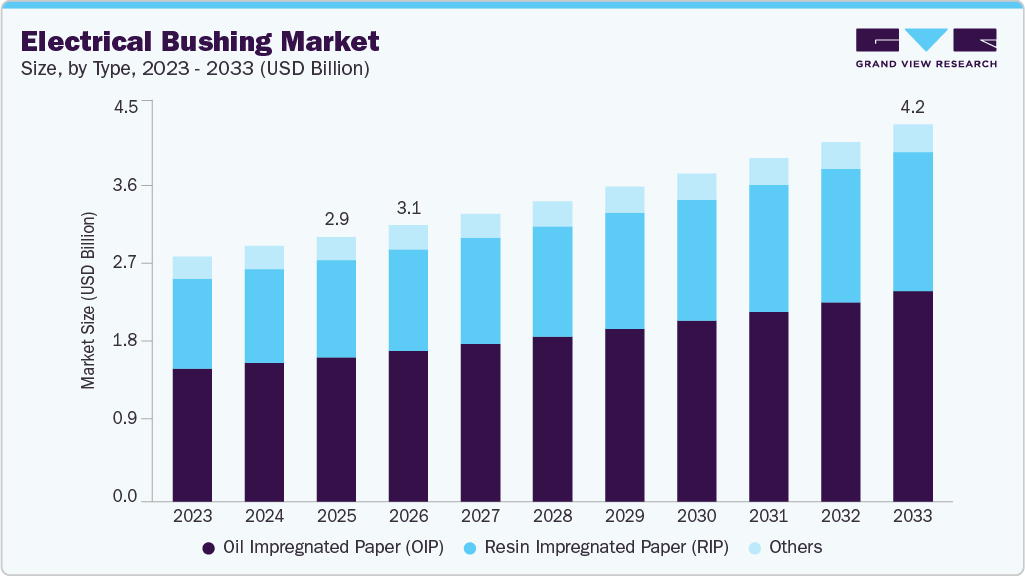
The global electrical bushing market was valued at USD 2.9 billion in 2025 and is estimated to reach USD 3.1 billion in 2026. It is projected to grow to USD 4.2 billion by 2033, expanding at a CAGR of 4.6% from 2026 to 2033.
This growth reflects the long-term investment cycle of electrical infrastructure. Rather than being driven by a single emerging technology, demand is closely connected to new transformer and substation installations, replacement of aging equipment, grid modernization, rising electricity consumption, and the integration of renewable power sources. The growing electricity requirements of electric vehicles, data centers, consumer electronics, and industrial facilities are also encouraging investment in power generation, transmission, and distribution networks.
Why Demand Keeps Climbing
The fundamental demand equation for electrical bushings starts with the expansion and modernization of power networks. Every new transformer, substation, and many forms of switchgear require reliable insulation systems capable of safely carrying electrical conductors through grounded enclosures.
Rising electricity consumption is therefore a major underlying driver. Growing adoption of electric vehicles, expanding data-center capacity, industrial electrification, and increasing digital infrastructure are placing additional pressure on power networks. Utilities are responding by adding generation and transmission capacity while upgrading distribution systems to improve reliability.
Grid modernization provides another important source of demand. Aging transformers, substations, and transmission equipment increasingly require replacement or upgrades, creating a recurring opportunity for bushing suppliers. In mature power systems, replacement demand can be just as important as demand generated by completely new infrastructure.
Renewable energy integration adds another layer. Wind, solar, and hydropower projects require connections to transmission and distribution networks, creating demand for transformers, substations, and associated high-performance insulation components. As renewable generation becomes more geographically distributed, reliable grid connections become increasingly important.
Emerging economies also provide significant opportunities. Rapid urbanization, industrial expansion, electrification programs, and investments in transmission and distribution infrastructure are increasing the need for medium- and high-voltage electrical equipment across Asia Pacific, Africa, and Latin America.
Download a free sample report or claim your copy of this full market intelligence report
What the Market Actually Buys
The oil-impregnated paper (OIP) segment remains the leading product category, accounting for over 54.0% of revenue in 2025. OIP bushings continue to be widely used because of their established reliability, insulation performance, and suitability for high-voltage applications. Their ability to withstand electrical and thermal stresses makes them an important choice for transformers and other critical power equipment.
At the same time, resin-impregnated paper (RIP) bushings are gaining attention as utilities place greater emphasis on safety and environmental performance. Because RIP designs are dry and oil-free, they can reduce fire and environmental risks, making them attractive for indoor substations, urban installations, and applications where environmental considerations are particularly important.
By insulation, porcelain accounted for more than 55.0% of revenue in 2025, retaining its position as the leading insulation material. Porcelain offers durability, a long service life, and strong resistance to mechanical, thermal, electrical, and environmental stresses. These characteristics continue to make it well suited to outdoor substations and transmission infrastructure exposed to weather, moisture, pollution, and temperature fluctuations.
Polymeric and glass alternatives are also becoming increasingly relevant. Polymeric bushings offer lower weight, installation flexibility, and resistance to mechanical impact, while glass-based designs provide strong dielectric performance and can facilitate visual inspection.
The medium-voltage segment held a 50.0% revenue share in 2025, making it the leading voltage category. Demand is supported by expanding urban infrastructure, industrial facilities, commercial developments, and distribution networks operating in the medium-voltage range.
By application, transformers represented more than 52.0% of revenue in 2025, making them the dominant application. The continued installation and replacement of transformers across transmission and distribution networks directly supports demand for transformer-mounted bushings. Switchgear represents another important application as utilities and industrial users invest in equipment for power protection, control, and automation.
Where Growth Is Concentrated
Asia Pacific accounted for more than 38.0% of global electrical bushing revenue in 2025, making it the largest regional market.
The region's position reflects a combination of rapid urbanization, industrial expansion, increasing electricity consumption, and large-scale investment in power generation and transmission infrastructure. China, India, Japan, Australia, South Korea, and Southeast Asian economies are expanding and modernizing electrical networks to support growing populations, industrial activity, and renewable energy deployment.
The growth story in Asia Pacific is therefore closely tied to both new infrastructure and modernization. New transmission networks and substations create demand for newly installed bushings, while the replacement of aging electrical assets creates an additional recurring requirement.
North America presents a different but equally important opportunity. Utilities in the U.S. and Canada are investing in grid modernization, aging infrastructure replacement, renewable energy integration, and resilience improvements. Increasing electricity requirements from data centers, electric vehicles, and energy storage are further contributing to infrastructure investment.
Europe is similarly focused on grid reinforcement, decarbonization, energy efficiency, and cross-border power transmission. HVDC corridors, offshore wind connections, and grid upgrades are supporting demand for high-performance bushings, while environmental and safety requirements are encouraging interest in dry-type and environmentally friendly designs.
Latin America and the Middle East & Africa offer additional opportunities through transmission expansion, renewable energy development, electrification, industrial projects, and urban infrastructure programs. In the Middle East, extreme heat and dust exposure also increase the importance of durable equipment capable of operating reliably under demanding conditions.
The Trend Worth Watching Beyond the Base Numbers
One of the most important shifts is that bushing technology is increasingly moving beyond basic insulation performance toward reliability, environmental performance, and condition monitoring.
Modern electrical networks are becoming more complex as renewable generation, energy storage, electric vehicles, data centers, and distributed energy resources increase the number and variability of electrical loads. In this environment, unexpected bushing failures can have consequences far beyond the component itself, potentially disrupting transformers, substations, and broader power networks.
This is creating interest in advanced insulation systems and digitally monitored bushings. Modern solutions can incorporate condition-monitoring capabilities for parameters such as temperature, partial discharge, moisture, and insulation health, allowing utilities to identify developing problems before they become major failures.
Sustainability is another increasingly important consideration. Manufacturers are developing dry-type, composite, and other environmentally focused designs that can reduce dependence on mineral oils and address fire-safety and environmental concerns. The transition is particularly relevant in urban substations and renewable energy installations, where safety and environmental requirements are becoming more demanding.
The result is a market where the competitive conversation is gradually shifting from simply supplying a bushing at the lowest possible cost toward delivering longer service life, higher reliability, lower environmental risk, and better visibility into equipment condition. As global power infrastructure becomes more valuable and more heavily utilized, those attributes are likely to become increasingly important purchasing criteria.
Looking for more in-depth data focusing on specific segments or regions? Get this report customized with inclusion of custom data sets to suit your exact business needs

 English
 Arabic
 French
 Spanish
 Portuguese
 Turkish
 Dutch
Dutch
 Italiano
 Russian
 Romaian
 Portuguese (Brazil)
 Greek
Greek
